
The pre-trip inspection
The test starts before the engine does. You walk the examiner around the tractor and trailer and show, out loud, that you know what you are checking and why. It is the longest single section and the one most people underestimate.
The examiner is not looking for a memorised speech. They want to see that you physically check each item — tire condition and inflation, wheel nuts, brake components, suspension, lights, reflectors, coupling, air lines and glad hands, the fifth wheel, landing gear and trailer doors — and that you would catch a real defect. Skip a section, rush a section, or describe something you didn't actually look at, and it counts against you.
Use the checklist
Our free pre-trip inspection checklist follows the same order ICBC examiners expect. Print it and run it until you no longer need it.
The in-cab air brake test
With the pre-trip done, you demonstrate the air brake system checks from the driver's seat. This is a fixed sequence: build pressure, check the governor cut-out, do the applied leakage test, confirm the low-air warning comes on at the right pressure, and confirm the spring brakes apply automatically when pressure drops far enough. You also test the tractor protection valve and the trailer brakes.
The examiner watches the gauges with you. Reading the wrong number, skipping a step, or not knowing what a result should be is a common way to fail. This is exactly why Tricon's own certified assessment officer runs practice air brake tests on-site before you ever see an ICBC examiner — see air brake testing on-site.
Coupling and uncoupling
You drop the trailer, pull away, and hook back up. The examiner is checking the order you do things in as much as whether the pin locks: chocks or brakes set, landing gear down before you pull the pin, air lines and electrical connected in the right order, the tug test to confirm the fifth wheel is locked, and a visual check under the trailer. Rushing this section is where a lot of otherwise strong drivers pick up marks.
Backing manoeuvres
Expect a straight-line back, an offset back, and an alley dock or a similar reverse into a marked bay. You are allowed pull-ups to correct, but each one costs you, and hitting a cone or the boundary line is serious. The examiner also watches your setup — how you position the truck before you start backing decides most of the outcome.
Tricon's yards in Surrey and Langley are set up with the same dimensions the test uses, and backing gets more repetition than any other yard skill in our 140-hour MELT course.
The on-road drive
The road portion covers city streets, a highway section and, depending on the office, hills and a railway crossing. The examiner is scoring the basics continuously: mirror checks before every lane change and turn, speed control, following distance, smooth shifting without grinding or coasting in neutral, lane position with the trailer, wide right turns that keep the trailer off the curb, and full stops.
- Shifting. If you test in a manual, missed gears and coasting are marked. Practice on real 13-speeds is part of MELT — see manual transmission training.
- Observation. Examiners mark what they can see you do. Turn your head; a glance from the eyes alone does not count.
- Railway crossings. Slow down, look both ways, and never shift on the tracks.
- Hills. Correct gear before the grade, not on it. Rolling back on a hill start is a common fail.
Where students lose marks
Across the drivers we prepare, the same handful of things come up:
- Missing items on the pre-trip because it was memorised as a script rather than learned as a check.
- Getting an air brake test number wrong under pressure.
- Pulling the fifth-wheel pin before the landing gear is down.
- Too many pull-ups on the alley dock because the setup was wrong.
- Not turning the head for mirror and shoulder checks.
- Right turns that put the trailer tires over the curb.
None of these are hard to fix. They are all a matter of repetition in the right truck with an instructor who has done the test and the job. That is what the 140 hours are for. If you are already licensed elsewhere or have done part of your training, an hourly individual lesson focused on the test sections is the fastest way to close the gap.
Frequently asked questions
How long is the ICBC Class 1 road test?
Plan for two to three hours from arrival to result. The pre-trip inspection and air brake test alone can take close to an hour, then coupling, backing and the on-road drive follow. The exact length depends on the examiner, the office and traffic.
Can I use a school truck for the road test?
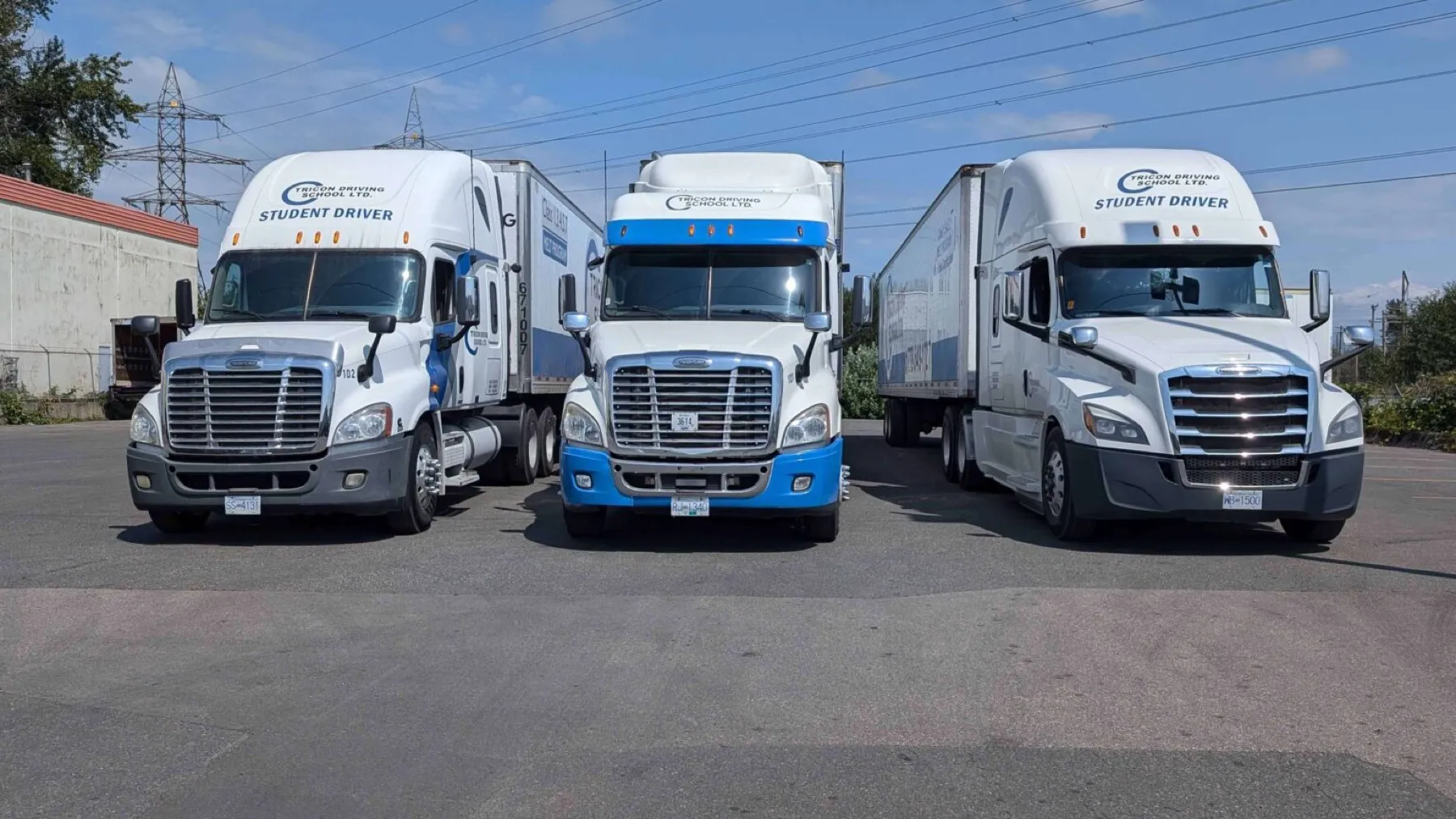
Yes, and you should. Tricon students take the test in the same tractor-trailer they trained in, so nothing about the mirrors, the shifter or the brake feel is a surprise on the day.
What happens if I fail the pre-trip?
If the examiner finds you missed something safety-critical, the test can end before you leave the yard. That is why Tricon runs the full pre-trip on every training day until it is automatic, not just once at the end of the course.
Does testing in an automatic make the test easier?
It removes the shifting element, but ICBC puts a permanent restriction on your licence that limits you to automatics. Most carriers want an unrestricted Class 1. See our Class 1 automatic page before you decide.