
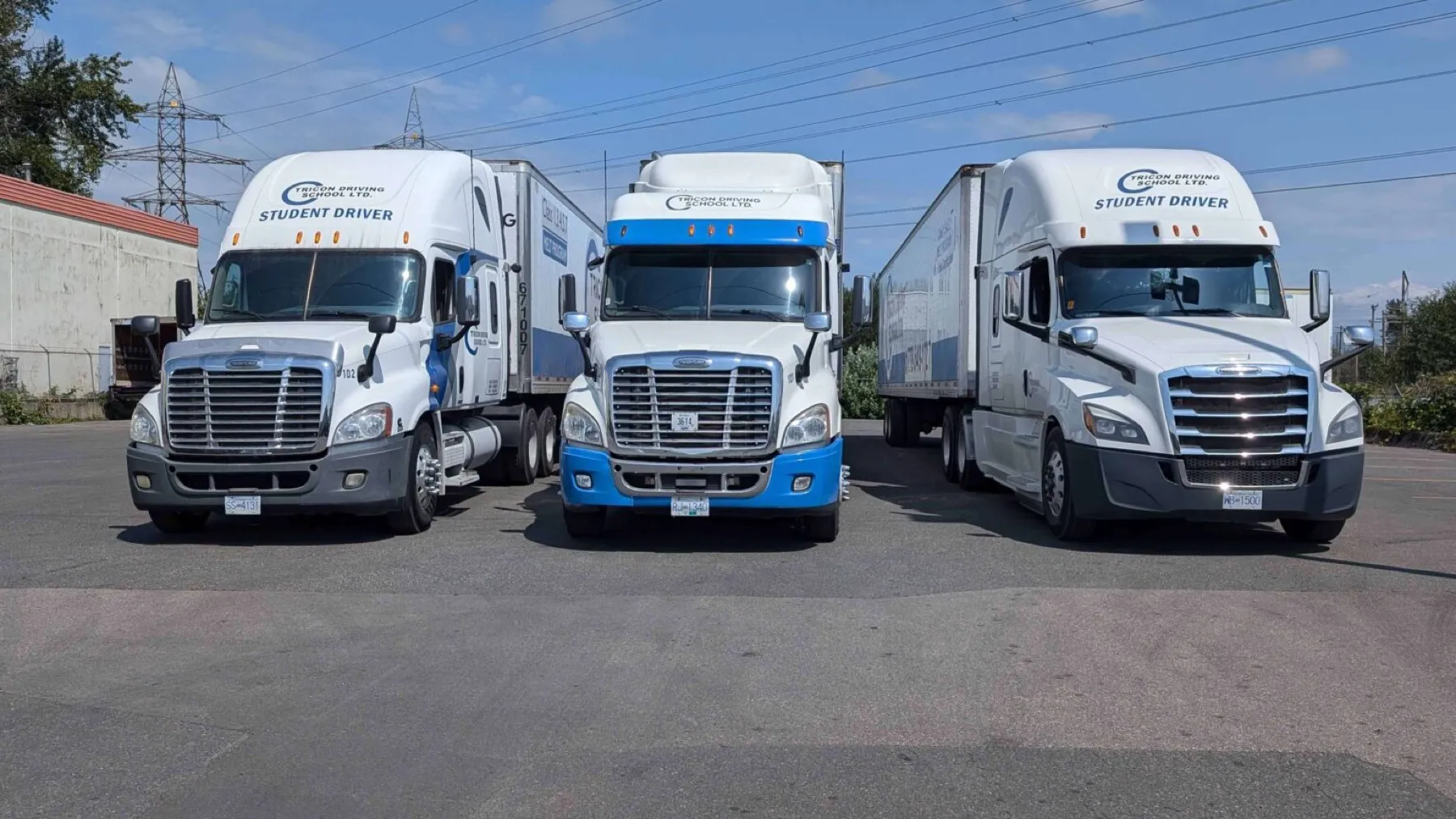
Car driving lessons at Tricon
Tricon is best known for putting people into Class 1 trucks. The car side of the school is the same idea at a smaller scale: an instructor in the passenger seat who has spent a working life on B.C. roads, and who would rather you leave a lesson genuinely able to drive than merely able to pass one test.
Nobody in British Columbia is required to take a driving lesson for a car licence. That is the honest starting point, and it is the opposite of Class 1, where the 140-hour MELT course is the law. You can practise entirely with a parent or a friend, book the Class 7 road test yourself, and pass. Plenty of people do.
Two things push people to book lessons anyway. The first is arithmetic: an ICBC-approved GLP course is the only mechanism that takes six months off your novice stage, and six months is a long time to spend with an N in the back window. The second is that most road-test failures are not caused by an inability to drive. They are caused by habits — a rolling stop, a shoulder check that became a glance, a lane position nobody at home ever mentioned — which are invisible to the person who taught you and obvious to an examiner in the first four minutes.
The short version
Lessons are optional in B.C. The approved GLP course is not mandatory either — but it is the only thing that shortens your novice stage, and it has to be finished during your learner stage. If you are going to do it, do it early.
Who books car lessons with us
- New drivers on a Class 7L. First time behind the wheel, working toward the Class 7 road test and an N.
- Drivers licensed outside Canada. You can already drive. What you need is B.C.'s expectations, and the specific things an ICBC examiner is watching for.
- People who have failed a road test. Usually one or two sessions on the exact thing that went wrong, then a mock test.
- Nervous and anxious drivers. Quiet streets first, at your pace, with no passenger-seat sighing. This is a real category and we treat it as one.
- Drivers returning after years off. A licence that lapsed, a long gap after an incident, or a move back to a city after a decade of rural driving.
- Future truck drivers. A full-privilege Class 5 is a prerequisite for Class 1 — a surprising number of our MELT students start here.
How graduated licensing works in B.C.
British Columbia does not hand out a car licence in one step. The Graduated Licensing Program (GLP) walks you through three stages, and each one removes restrictions rather than adding skills you are assumed to already have. Understanding the shape of it matters, because almost every question people ask us — "how soon can I test?", "why is my friend already on a 5?" — is really a question about where they sit in this sequence.
| Stage | How you get there | Minimum time | Key restrictions |
|---|---|---|---|
| Class 7L — Learner | Turn 16, pass the knowledge test (40 of 50 questions) and a vision screening. Parental consent if you are under 19. | 12 months | Supervisor in the front seat, one other passenger, no midnight–5 a.m. driving, zero alcohol and drugs, no devices at all, red L displayed. |
| Class 7N — Novice | Pass the Class 7 road test. | 24 months, or 18 with an approved GLP course | One passenger unless all are immediate family or a qualified supervisor is with you, zero alcohol and drugs, no devices, green N displayed. |
| Class 5 — Full | Pass the Class 5 road test — replaced by a Driving Record Assessment from 19 October 2026. | — | Standard licence. From 19 October 2026, a 12-month zero alcohol and drug restriction period follows the upgrade. |
On your L, the rules are strict on purpose
- A supervisor aged 25 or over holding a valid Class 1–5 licence must sit beside you in the front passenger seat. From 19 October 2026 the minimum supervisor age drops to 22.
- One passenger besides your supervisor. From 19 October 2026 you may carry more if they are all immediate family.
- No driving between midnight and 5 a.m.
- Zero alcohol or drugs in your blood, and no electronic devices — including hands-free.
- The red L sign displayed on the back of the vehicle, visible to drivers behind you.
ICBC recommends at least 60 hours of practice before you attempt the Class 7 road test. That is a floor, not a target — and it is far easier to reach if some of those hours are structured rather than laps of the same familiar streets.
What changes on 19 October 2026
This is the biggest change to B.C.'s car licensing rules in twenty years, and it is worth reading properly before you book anything — for some drivers it removes a test entirely, and for others it changes when they should be booking lessons.
The second road test is being scrapped
From 19 October 2026, Class 7 novice drivers with a clean record no longer sit a Class 5 road test. They upgrade through a Driving Record Assessment at an ICBC or Service BC office instead. The Class 7 road test — the one that gets you your N — is unchanged, and still very much a road test.
The Driving Record Assessment
Rather than judging you on one drive, ICBC looks at what your record says about the two years you have just spent driving. To qualify you must meet all of the following:
- Under 25: 24 months of safe driving in the novice stage — or 18 months if you completed an approved GLP course during your learner stage. An unfinished course does not count.
- 25 or older: 12 months of safe driving.
- No excessive speed convictions during the qualifying period.
- No electronic device convictions during the qualifying period.
- No prohibitions or suspensions during the qualifying period.
Pass, and you are issued a Class 5 licence carrying a 12-month restriction period with a zero blood-alcohol and drug limit. Fail to meet the criteria and the novice period effectively restarts — which is the whole point of the redesign. As the province put it when announcing the change, experience gained over time predicts long-term safety about as reliably as a single road test does.
The other changes worth knowing
- Learner stage, 25 and over: shortened from 12 months to 9 months. Under 25 it stays at 12.
- Novice stage, 25 and over: reduced from 24 months to 12 months.
- Supervisor age for an L driver drops from 25 to 22.
- An immediate-family passenger exemption is introduced, so L and N drivers can carry more than one passenger when everyone in the car is family.
- Driving Record Assessments can be done at Service BC offices as well as ICBC driver licensing offices.
Have a Class 5 road test booked after 19 October?
ICBC will email you a cancellation along with instructions for upgrading through the record assessment instead — you do not need to do anything to trigger it. Up until that date you can still take the second road test voluntarily if you would rather clear it the old way.
The ICBC-approved GLP course
"Driving lessons" and "an approved GLP course" are not the same product, and the difference is worth money. Any school can sell you an hour in a car. Only a course built to ICBC's approved curriculum earns the six-month reduction on your novice stage.
Thirty-two hours in total. Two conditions attach to it, and both catch people out:
- It must be completed within one year, and while you are in the learner stage. Finish your Class 7 road test first and the reduction is gone.
- Your record has to stay clean — no at-fault crashes, no traffic convictions, no prohibitions. The reduction is a reward for the whole novice period, not a receipt for the course.
A course shortens the N, not the L
This is the single most common misunderstanding we hear on the phone. The approved course does not let you take the Class 7 road test early — the learner stage is still 12 months (9 from 19 October 2026 if you are 25 or over). What it does is cut the novice stage from 24 months to 18. High-school students may also earn two grade 11 credits for completing it.
Course availability varies by location and by season. Call us at (778) 549-1727 and we will tell you what is running near you, when the next in-class block starts, and — if the course does not make sense for your situation — say so rather than sell it to you.
What a lesson actually covers
Lessons are built in a deliberate order. The early ones happen where nothing much can go wrong, and each one adds a layer rather than a location. If you already drive, we start further along — the first session is partly an assessment so we are not spending your money teaching you things you can already do.
Controls and the cockpit drill
Seat, mirrors, head restraint, belt. Where the biting point is, what the pedals feel like, and the reference points that tell you where the corners of the car are without guessing.
Steering, lane position and speed
Holding a lane without wandering, smooth steering through corners, and matching your speed to the road rather than to the car in front of you.
Intersections and right of way
Stop lines and the full stop that examiners actually want. Uncontrolled intersections, four-way stops, and the unprotected left turn that fails more road tests than anything else in the province.
Observation and shoulder checks
Mirrors on a cycle instead of on alarm, real shoulder checks rather than a chin twitch, and scanning far enough ahead that you stop being surprised.
Lane changes, merging and highway
Building a gap, matching speed on an on-ramp, and holding a steady position at 90 km/h — the part most learners get least practice at, because supervisors avoid it.
Parking and reversing
Parallel parking, stall parking, reverse stall, and hill parking with the wheels turned the right way — which direction depends on the curb and on which way you are facing.
Hazard perception and space
Following distance you can defend, reading a cyclist's line, school and playground zones, transit buses pulling out, and the pedestrian who has not seen you.
Night, rain and winter
Wet-road braking distances, glare and headlight use, fog, and how a B.C. winter changes the timing of everything you have just learned.
Road-test routes and mock tests
The roads around the licensing office, the manoeuvres examiners commonly ask for, and a full mock test scored the way the real one is — so test day is a repeat, not a first.
The Class 7 road test
The Class 7 test is the one that gets you your N, and it is not going anywhere — the 2026 changes remove the second test, not this one. It is a supervised drive on public roads with an ICBC examiner scoring what you do.
What to bring, and what the car needs
- Accepted identification — one piece of primary ID and one piece of secondary ID.
- A safe, reliable and insured vehicle with a Canadian licence plate. You give the examiner the plate number at the counter.
- All GPS and navigation switched off, and no audio, video or other recording devices running. Using them can get the test cancelled outright.
Where road tests are commonly lost
- The rolling stop. Slowing to walking pace at a stop sign is not stopping, and it is visible from the passenger seat every single time.
- Missing shoulder checks. Before every lane change, every pull-out, and every right turn where a cyclist could be beside you.
- Speed. Both directions. Over the limit fails you; driving 10 under because you are nervous is also marked, and it is the more common of the two.
- The unprotected left. Creeping into the intersection, then committing late through a gap that has already closed.
- Examiner intervention. If the examiner has to say something or touch a control to keep the car safe, the test ends there.
None of these are hard to fix. All of them are hard to notice in yourself, which is the argument for a mock test with somebody scoring it — ideally about two weeks before your appointment, so there is time to work on whatever it turns up.
Test coming up and not sure you're ready?
Book a mock road test. You will get a scored run and a straight answer about whether to keep the appointment or move it.
Your path to a full Class 5
Start to finish, here is the whole sequence under the rules as they will stand from 19 October 2026 — and where lessons fit into it.
-
Study, then pass the knowledge test
Fifty multiple-choice questions; you need 40 right, plus a vision screening. ICBC's Learn to Drive Smart guide and the free online practice test are the whole syllabus — take the practice test until passing it is boring.
At an ICBC office -
Get your Class 7L learner licence
From your 16th birthday. Under 19, you will need a parent or guardian to consent. The L sign goes in the back window the same day.
At an ICBC office -
Take the approved GLP course — early
Sixteen hours in class, twelve in the car, four flexible. It must be finished within a year and while you still hold the L. This is the step that takes six months off your novice stage, and the only one that can.
With us -
Build your practice hours
ICBC recommends at least 60 hours with a supervisor. Mix in the uncomfortable conditions on purpose — rain, dusk, highway, a busy parking lot — rather than saving them for after you are licensed.
With a supervisor -
Mock road test, then the real one
After 12 months on your L — 9 if you are 25 or over, from 19 October 2026. We run a scored mock test on the routes around the licensing office first, so the only new thing on the day is the examiner.
With us -
Pass the Class 7 road test and get your N
Green N in the back window. The restrictions loosen, but zero alcohol and drugs, no devices and the passenger limit all continue.
At an ICBC office -
Drive cleanly through the novice stage
24 months under 25, 18 with a completed GLP course, 12 months if you are 25 or over. No excessive speed convictions, no device convictions, no prohibitions — this period is now the test.
On your own -
Driving Record Assessment, then your Class 5
At an ICBC or Service BC office from 19 October 2026 — no second road test. A 12-month zero alcohol and drug restriction period follows, and then the licence is simply a licence.
At ICBC or Service BC
Why learn with Tricon
There is no shortage of driving schools. What differs between them is who ends up in the passenger seat, whether the schedule bends around your life or the other way round, and whether anyone picks up the phone at seven on a Sunday evening.
Instructors from the commercial side
Our people spend the rest of their week teaching tractor-trailers on mountain highway. The habits they bring to a car lesson — space, planning, looking a long way ahead — are the habits that keep you out of trouble at 22.
Open 9am to 9pm, every day
Weekends and holidays included. Most learners are fitting lessons around school, shift work or a job they cannot move, so evenings and Sundays are normal hours here, not favours.
An honest count of lessons
We would rather tell you after the first session that you need three lessons than sell you ten. If you are already close to test-ready, that is what we will say.
4.6★ Surrey · 5.0★ Langley on Google
A BC Trucking Association member school with a decade of licensing people in this province — most of them nervous on day one, all of them driving now.
A path that keeps going
A full-privilege Class 5 is the door to Class 3 and Class 1. If driving turns into a career rather than a commute, the next course is in the same building.
Vancouver Island and the mainland
Car lessons run from our Duncan/Nanaimo location, with the commercial programs continuing at the Surrey and Langley yards.
Duncan / Nanaimo
Vancouver IslandAddress and hours coming soon
Car driving lessons run from our Duncan/Nanaimo location on Vancouver Island. Call (778) 549-1727 for start dates and to get on the list.
Car driving lessons — frequently asked questions
Do I need driving lessons to get a licence in B.C.?
No. Unlike Class 1 — where the 140-hour MELT course is mandatory — B.C. requires no professional instruction at all for a car licence. You can practise entirely with a qualified supervisor and book the road test yourself.
Two reasons people book anyway: an ICBC-approved GLP course is the only thing that takes six months off the novice stage, and most road-test failures come from habits the person who taught you never noticed.
What is an ICBC-approved GLP course?
A set curriculum ICBC approves for new drivers: at least 16 hours in class, at least 12 hours in the vehicle, and 4 hours of flexible or discretionary time — 32 hours in total.
Complete it within one year and while you are still in the learner stage, keep your record clean, and if you are under 25 your novice stage drops from 24 months to 18. High-school students may also earn two grade 11 credits for it.
How long do I have to hold my L before the road test?
At least 12 months of supervised practice. From 19 October 2026 that drops to 9 months for drivers aged 25 and over; for drivers under 25 it stays at 12.
Worth being clear about, because it is the question we most often get wrong answers to: taking a GLP course does not shorten the learner stage. It shortens the novice stage that comes after it. ICBC recommends at least 60 hours of practice before you test.
Is the Class 5 road test really being scrapped?
Yes — the second road test only. From 19 October 2026, Class 7 novice drivers with a clean record upgrade to a Class 5 licence with restrictions through a Driving Record Assessment instead of a second drive.
The Class 7 road test that gets you your N is unchanged. If you have a Class 5 road test booked on or after 19 October 2026, ICBC will email you a cancellation with instructions for upgrading. Before that date you can still take it voluntarily.
What is the Driving Record Assessment?
A review of your record rather than a drive, done at an ICBC or Service BC office. To qualify you need all of the following:
- Your novice period completed — 24 months if you are under 25, 18 months if you are under 25 and finished an approved GLP course, or 12 months if you are 25 or older
- No excessive speed convictions during that period
- No electronic device convictions during that period
- No prohibitions or suspensions during that period
Meet them and you are issued a Class 5 carrying a 12-month restriction period with a zero blood-alcohol and drug limit. Fall short and the novice period restarts.
I'm 25 or older. Is the process shorter for me?
From 19 October 2026, considerably. The learner stage drops from 12 months to 9, and the novice stage from 24 months to 12 — so roughly three years of graduated licensing becomes closer to eighteen months.
The restrictions themselves do not change. An L is still an L, whatever your age.
How many lessons will I need?
It depends entirely on what you bring to the first one. A 17-year-old who has never driven usually wants the full GLP course plus supervised practice between lessons. Someone who drove for a decade in another country often needs two or three sessions to learn what B.C. expects.
We treat the first lesson partly as an assessment and tell you honestly what we think, rather than selling a package before we have seen you drive.
Can I use your car for the ICBC road test?
Call and ask — availability depends on the location and the day. ICBC's requirement is a safe, reliable and insured vehicle with a Canadian licence plate, whoever it belongs to.
If you are testing in a familiar car of your own, we would generally rather run your last lesson in that car than in ours.
I have a driver's licence from another country. Do I start over?
Usually not from the beginning. Depending on which country issued your licence, ICBC may exchange it directly, or ask you to pass a knowledge test and one or both road tests. ICBC may also credit driving experience earned abroad toward the graduated licensing stages, so bring proof of your licence history.
ICBC makes the determination, not us — but we read these files often. Call before you spend anything and we will tell you what we think you are looking at.
I'm an anxious driver. Is that a problem?
It is one of the most common reasons people call us, and it is not a problem — it is the thing to say when you book, so we can plan the first lesson around it.
That usually means quiet residential streets, a shorter first session, and no highway until you ask for it. Anxiety in a car is almost always about not knowing what happens next, and it fades as the sequence becomes familiar.
What do lessons cost?
Call (778) 549-1727 for current pricing on single lessons, packages and the full GLP course. We quote on the phone so the number matches what you actually need.
The provincial grants on our funding page are aimed at commercial training rather than car lessons, but it is worth a conversation if a Class 5 is a step toward a driving job.
Where do you teach car driving lessons?
Car lessons run from our Duncan/Nanaimo location on Vancouver Island, alongside the commercial programs. Call (778) 549-1727 for start dates and to get on the list.
Our Surrey yard (12511 82 Ave) and Langley yard (8380 216 St) run the commercial side — Class 1 MELT, Class 3, air brake certification and individual lessons. Phones are answered 9am to 9pm every day.