
What is Class 1 MELT?
Class 1 MELT — Mandatory Entry-Level Training — is the standardised course every new Class 1 driver in British Columbia has to finish before ICBC will let them attempt the Class 1 road test. It has been the law since 18 October 2021. It is not an optional upgrade, and there is no shortcut around it.
The curriculum was built on National Safety Code Standard 16, then adapted for the province by ICBC and the Ministry of Transportation and Infrastructure. B.C.'s version is deliberately heavier than the national floor in two places that matter here: air brakes, and driving in the mountains. A driver who gets licensed in Surrey can be descending a long grade on the Coquihalla, loaded, in weather, within a week of starting work — so the province decided that shouldn't be the first time they'd ever done it.
The whole course is 140 hours: 47 hours of theory and 93 hours of practical training. Every one of those hours is logged against your name on an ICBC attendance form. When you finish, your school issues you an MV2970 Class 1 MELT Declaration of Completion and files a copy with ICBC.
The short version
No Declaration of Completion, no Class 1 road test. You can book the test before you finish the course — but you cannot sit it until ICBC has your DoC on file.
Who has to take MELT
- Anyone applying for their first Class 1 licence in Canada.
- Drivers who have held a Canadian Class 1 licence for less than 12 months.
- Anyone whose Class 1 licence and training come from outside Canada, regardless of how many years they have driven. No credit is given for foreign training.
- Holders of a B.C. Class 2, 3 or 4 licence moving up to Class 1 — a commercial licence earns no advanced standing.
Who may be exempt
- Your B.C. Class 1 licence expired less than three years ago and you're still eligible to renew it.
- You've held a valid Canadian Class 1 licence for 24 consecutive months or more within the past three years.
- You completed a full MELT course in Alberta, Ontario, Saskatchewan, Manitoba, Newfoundland and Labrador, the Northwest Territories or New Brunswick. Ontario Class A graduates with under 24 months' experience still owe B.C. the air brake portion.
Exemptions are decided by ICBC on your driving record, not by us — but we read these files every week. Call us at (778) 549-1727 before you pay for anything and we'll tell you honestly which category you land in.
Inside the 140 hours
MELT hours are not filler, and they are not left to a school's discretion. ICBC sets a minimum for every single module and for every learning environment — classroom, in-yard, off-road manoeuvres and on-highway driving. Here is exactly how the 140 hours are allocated, straight from ICBC's Class 1 MELT Course Standards and Curriculum Framework.
| Module | Theory | In-yard | Off-road | On-road | Total |
|---|---|---|---|---|---|
| 1. Overview of the trucking industry | 3 | — | — | — | 3 |
| 2. Vehicle components & systems | 3.5 | 2 | — | — | 5.5 |
| 3. Driving techniques | 6 | — | — | 40 | 46 |
| 4. Professional driving habits | 4 | — | — | 10 | 14 |
| 5a. Backing | 2 | — | 12 | — | 14 |
| 5b. Coupling & slides | 1 | 1 | 6 | — | 8 |
| 5c. Chain-up | 1 | 2 | — | — | 3 |
| 6. Documents, regulations & planning | 5 | — | — | — | 5 |
| 7. Vehicle inspection activities | 3.5 | 10 | — | — | 13.5 |
| 8. Hours of service compliance | 5 | — | — | — | 5 |
| 9. Cargo securement & loss prevention | 4 | 2 | — | — | 6 |
| 10. Air brakes | 9 | 2 | — | — | 11 |
| By learning environment | 47 | 19 | 18 | 50 | 134 |
| Mandatory flexible practical time | — | 6 hours, practical only | 6 | ||
| Total | 47 theory + 93 practical | 140 | |||
The 50 on-road hours, broken down
On-highway time isn't a single lump either. ICBC specifies how much of it must be driven in each vehicle configuration, because an empty trailer, a loaded trailer and a bobtail tractor all behave differently — and the one that surprises new drivers is the empty one.
| Configuration | Minimum hours |
|---|---|
| Loaded trailer | 38 |
| Unloaded trailer | 4 |
| Bobtail (tractor only) | 4 |
| Student / instructor choice | 4 |
| Minimum on-road total | 50 |
Six hours that belong to you
Six of the 140 hours are mandatory flexible practical time — they cannot be skipped, and they cannot be spent in a classroom. They exist so your instructor can put extra time exactly where you're weakest, whether that's offset backing, pre-trip, or a last polish before your road test. Tell your instructor what's worrying you; that's what the time is for.
How the schedule actually runs
ICBC also caps how much training can be crammed into a day, which is why a legitimate MELT course cannot be finished in a fortnight. No more than eight hours of combined instruction per day. No more than seven hours of classroom, six hours in the yard, or four hours in the cab — with one exception: up to 20 of your in-cab hours may be used to stretch a day to ten hours for highway and mountain driving, so you learn what a long day behind the wheel actually feels like.
Theory can't be front-loaded either; ICBC requires it to be interleaved with practical work. And the calendar has a floor as well as a ceiling: the course cannot be completed in fewer than 30 days, and must be finished within 365 days of your enrolment date.
What you'll learn — all ten modules
The MELT curriculum is organised into ten modules. Together they take you from "I have never sat in a tractor" to a driver who can inspect a rig, couple it, back it into a dock, run it legally across a province and hand a clean logbook to an enforcement officer.
Overview of the trucking industry
How the industry is regulated, what employers expect, WHMIS and workplace hazards, staying fit for work on the road, and recognising and reporting human trafficking.
Vehicle components & systems
Every control, gauge and system on a modern tractor-trailer, and what each one is telling you — in the classroom and then hands-on at the truck.
Driving techniques
The largest module in the course. Starting and moving a loaded combination, shifting, turning, lane management, speed and space on the highway, and fuel-efficient habits that employers notice.
Professional driving habits
Defensive and cooperative driving, hazard perception, sharing the road, and handling an emergency or collision scene like a professional rather than a bystander.
Off-road tasks & manoeuvres
Straight-line, offset and alley-dock backing. Coupling and uncoupling. Sliding the fifth wheel and trailer axles. Chaining up — the skill nobody enjoys and every B.C. driver needs.
Documents, regulations & planning
Bills of lading, permits and border paperwork, the arithmetic of weights and distances, trip planning, and thinking two hours ahead instead of reacting.
Vehicle inspection activities
The NSC 13 pre-trip, component by component, and the difference between a minor defect and a major one that puts the truck out of service. Ten of these hours are spent at the vehicle.
Hours of service compliance
Federal and provincial HOS rules, cycles and off-duty requirements, electronic logging devices, and what an inspector will actually ask to see at the scale.
Cargo securement & loss prevention
Working load limits, tiedowns, blocking and bracing to the national standard — plus the practical side of protecting a load from damage, theft and a claim against your record.
Air brakes
How an air brake system works, pre-trip and en-route air brake inspection, identifying defects, and checking and adjusting pushrod travel. 15.5 hours in total once yard practice is counted.
Your air brake training is already in the course
You do not need to buy a separate air brake course to get your Class 1. B.C. builds 15.5 hours of air brake theory and practical work into MELT — roughly double the national minimum — because brake fade on a long grade is not a theoretical problem in this province. If you only need the endorsement on its own, that's our standalone air brake course.
The trucks you'll train in
ICBC doesn't let schools teach Class 1 in whatever happens to be in the yard. The training combination has to meet a specification, and it's a demanding one — because the point is that your first real truck shouldn't feel bigger than your training truck.
- A tractor-and-semi-trailer or B-train combination with a loaded weight of at least 32,000 kg.
- A full air brake system on the tractor and on every trailer.
- Minimum tandem-axle tractor and tandem-axle trailer, with a sliding fifth wheel.
- A trailer at least 14.63 m (48 ft) long, set at a minimum 12.5 m (41 ft) from kingpin to rear axle centre.
- Valid inspection certificates on both tractor and trailer.
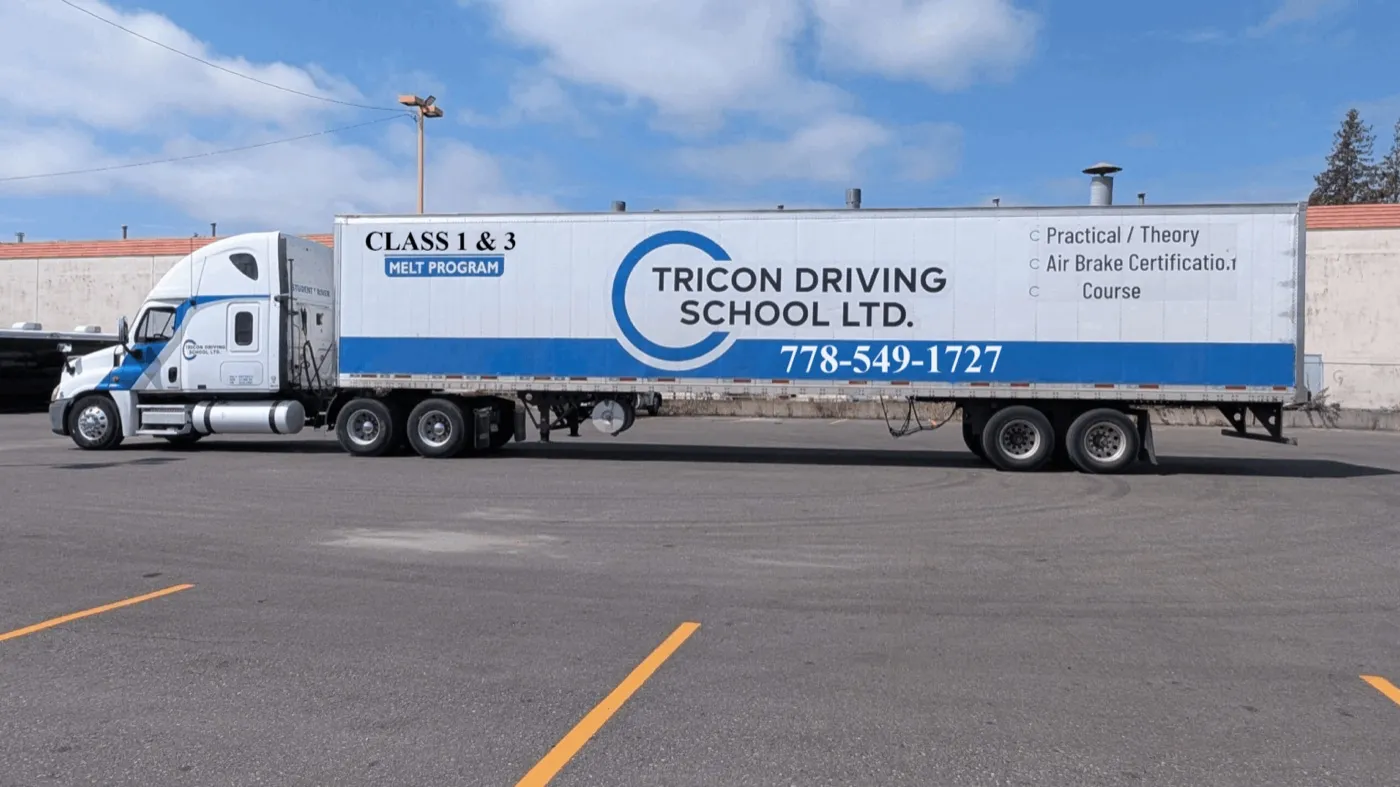
Tricon maintains its own fleet of Class 1 training units across our Surrey and Langley yards, so training runs on schedule rather than around one truck's availability. You train on the same equipment you'll be assessed on.
Manual or automatic? Read this before you decide
This is the single decision on this page that can quietly cost you jobs, so it's worth being blunt about it.
During MELT, up to 10 of your on-road hours may be driven in a vehicle with an automatic or automated transmission. The rest of your training must be in a manual with at least a 13-speed transmission. You then choose which one to take the ICBC road test in.
Passing in an automatic gets you a restricted licence
If you qualify on the Class 1 road test in an automatic or automated-transmission vehicle, ICBC issues a licence that prohibits you from driving manual Class 1 vehicles. A large share of B.C. carriers still run manuals, and a restricted licence takes you out of the running for those jobs on the first line of the application. Unless you have a specific reason not to, test on the manual — and tell your instructor early so they can build your hours around it. For more on how the 13-speed is taught — and what to do if you're already carrying a restricted licence — see our manual transmission training page. If you're weighing the automatic road test on purpose, our Class 1 automatic transmission training page spells out exactly what the restriction covers and who it works for.
Before you can enrol
MELT sits in the middle of the licensing process, not at the start of it. There are a few boxes ICBC needs ticked before you're allowed to book a single hour — most importantly, you must already hold a Class 1 learner's licence, because your on-road training happens on it.
- Be at least 19 years old. That's the minimum age for a Class 1, 2 or 4 licence in B.C.
- Hold a full-privilege B.C. Class 5 or 6 licence (or an out-of-province equivalent). A Class 7 novice licence is not enough.
- Pass the Class 1 knowledge test and road signs test. In B.C. the Class 1 and air brake knowledge questions are on a single test — so study the air brake chapters of the commercial driving guide properly, not last.
- Hold a valid B.C. Class 1 learner's licence before you enrol. Any training taken before you have it does not count toward your MELT hours.
- Meet the commercial medical standards. You'll declare any conditions up front and complete a Driver's Medical Examination Report (DMER) with your physician. If you're uncertain about your fitness, you can ask ICBC for a Class 1 DMER before you commit to the course.
- Have a clean enough record. Fewer than four penalty-point incidents in the past two years, and no driving-related criminal convictions in the past three.
- Clear any fines or debts owing to ICBC.
Not sure where you stand on any of these? That's a five-minute phone call, and it's free. (778) 549-1727.
Your path to a Class 1 licence
From the first phone call to a licence in your wallet, here's the whole sequence — and where we come in.
-
Confirm you're eligible
Age, licence class, driving record, medical. Call us and we'll go through it with you before you spend anything.
-
Study and pass the knowledge test
Class 1 and air brake knowledge on one test, plus road signs. ICBC's free online practice test is the best preparation there is — take it until you're bored of passing it.
At an ICBC office -
Get your Class 1 learner's licence
This is your ticket to legally drive a training truck on the road. You must have it in hand before you enrol.
At an ICBC office -
Enrol at Tricon and start your 140 hours
Theory and practical training are interleaved by design — you learn the pre-trip in class and then perform it at the truck the same week. Every hour is logged on your ICBC attendance record.
With us -
Pass your in-course assessments
Six practical assessments — highway and mountain driving, pre-trip inspection including air brakes, coupling and uncoupling, chain-up and slides, backing, and basic and urban driving — plus three written assessments at a minimum overall mark of 80%. Each must be passed twice.
With us -
Receive your Declaration of Completion
We issue your MV2970 and file the ICBC copy. Keep your student copy safe and bring it with you to the driver licensing office — ICBC has to see it on file before you're allowed to attempt the road test.
With us -
Pass the ICBC Class 1 road test
A pre-trip inspection including air brakes, then the drive. Complete your driver's medical exam, and your full-privilege Class 1 licence is issued.
At an ICBC office
Not sure which step you're on?
Tell us what's on your licence today and we'll map out exactly what's left — no obligation, no sales pitch.
Why train with Tricon
Every ICBC-approved school in B.C. teaches the same 140 hours. What separates them is where those hours are spent, who's sitting in the passenger seat, and whether the school picks up the phone at seven on a Sunday evening when you're trying to arrange your week.
Real mountain grades, not a video
Highway and mountain driving is a required MELT assessment, and we run it on real B.C. mountain highway including the Coquihalla. Your first long descent happens with an instructor beside you.
Instructors who have done the job
Our Class 1 instructors hold ICBC MELT-designated instructor licences and have driven commercially themselves. You get the regulation and the reason behind it.
Open 9am to 9pm, every day
Including weekends and holidays. Most of our students are fitting 140 hours around a job they can't quit yet, so we build schedules around shift work rather than the other way round.
Yards in Surrey and Langley
Two Metro Vancouver training yards, plus a third location in Duncan/Nanaimo, so your backing practice isn't a 90-minute commute each way.
4.6★ Surrey · 5.0★ Langley on Google
By drivers who now hold a Class 1 licence. We're a BC Trucking Association member school, and we've put more than 500 students through commercial training.
In-house funding available
We finance training directly as well as helping students apply for provincial grants — so the course fee doesn't have to arrive as one lump sum.
We train Class 1 students from across Metro Vancouver and the Fraser Valley — Surrey, Langley, Delta, Abbotsford, Burnaby, Richmond, Coquitlam and New Westminster.
Paying for your MELT course
ICBC does not set the price of MELT — every approved school sets its own, which is why you'll see a range across the province. We quote current Class 1 MELT pricing over the phone so you get an accurate number for your situation, including whether any of your hours can be credited and what a payment schedule would look like.
You may not have to carry the full cost yourself. Several provincial programs exist specifically to get new drivers into the trucking industry:
Community Workforce Response Grant
Provincial funding aimed at filling skills gaps in local labour markets — commercial driving is a recurring priority.
Skill Enhancement Training Grant
Support for individuals training toward in-demand occupations in British Columbia.
Indigenous Skills Training Development Fund
Dedicated training funding for Indigenous learners across B.C.
B.C. Employer Training Grant
If a carrier is willing to sponsor you, this covers a large share of the employer's cost of training a new driver.
In-house funding at Tricon
We also finance training directly, so you can start the course before the whole fee is in the bank. Ask about it when you call — and see our funding options page for the full picture.
Class 1 MELT — frequently asked questions
How long is the Class 1 MELT course in BC?
140 hours: 47 hours of theory and 93 hours of practical training, made up of 19 hours in-yard, 18 hours of off-road manoeuvres, 50 hours of on-road driving and 6 hours of mandatory flexible practical time.
ICBC also sets a floor and a ceiling on the calendar. The course cannot be completed in fewer than 30 days, and it must be finished within 365 days of your enrolment date. In practice most students finish in somewhere between four and eight weeks depending on how many days a week they can commit.
Is MELT mandatory in British Columbia?
Yes. Since 18 October 2021, anyone applying for a first B.C. Class 1 driver's licence must complete an ICBC-approved Class 1 MELT course and be issued a Declaration of Completion before they're permitted to attempt the Class 1 road test.
There are no sector-specific exemptions — it doesn't matter whether you intend to run long-haul, local delivery, logging or dump truck. B.C.'s trucking and driver-training industries both asked for it that way.
How much does Class 1 MELT cost in BC?
ICBC deliberately doesn't set the price — each approved school prices its own course, which is why quotes vary across the province.
Call us at (778) 549-1727 for current Tricon pricing. We'll also walk you through in-house financing and provincial grants such as the Community Workforce Response Grant, the Skill Enhancement Training Grant, the Indigenous Skills Training Development Fund and the B.C. Employer Training Grant.
Does Class 1 MELT include air brake training?
Yes — you don't need to buy it separately. Air brakes are module 10 of the curriculum: 9 hours of theory plus 6.5 hours of practical work, 15.5 hours in total once the air brake time inside your pre-trip inspection lessons is counted.
That's close to double the minimum under National Safety Code Standard 16, and it's intentional. Note that the air brake knowledge questions are also folded into the Class 1 knowledge test you take before the course.
Do I need a Class 1 learner's licence before I start MELT?
Yes, and this catches people out. ICBC requires a valid B.C. Class 1 learner's licence before you enrol — any training taken before you hold it does not count toward your mandatory hours.
To get it you'll need to pass the Class 1 knowledge test (air brake questions included on the same test) and the road signs test, and meet the medical standards.
Can I take Class 1 MELT in an automatic truck?
Partly. Up to 10 of your on-road hours may be driven in an automatic or automated-transmission vehicle; everything else must be in a manual with at least a 13-speed transmission.
You choose which to use for the road test — but qualifying in an automatic gets you a restricted Class 1 licence that bars you from manual-transmission Class 1 vehicles. Plenty of B.C. carriers still run manuals, so that restriction can cost you jobs. Our advice is to test on the manual.
I hold a Class 1 licence from another province or country. Do I still need B.C. MELT?
It depends on where and for how long:
- Another Canadian province: B.C. recognises the full MELT courses from Alberta, Ontario, Saskatchewan, Manitoba, Newfoundland and Labrador, the Northwest Territories and New Brunswick. Ontario Class A graduates with less than 24 months of experience must still complete B.C. air brake training (see our Ontario AZ air brake upgrade).
- Canadian Class 1 held 24+ consecutive months within the past 3 years: generally no MELT required.
- Held 12–24 months: generally no MELT, provided you qualify on a B.C. Class 1 road test within 12 months and within two attempts.
- Held under 12 months, or licensed outside Canada for any length of time: full B.C. MELT is required. No credit is given for training completed outside Canada.
ICBC makes the final determination based on your driving record. Call us first — we'll tell you what we think you're looking at before you spend anything.
My B.C. Class 1 licence expired. Do I have to retake MELT?
Generally not, as long as it has been expired for less than three years and you're otherwise eligible to renew. Past three years you're treated as a new applicant and the full 140 hours apply.
How many students will be in my class?
ICBC caps class sizes in every learning environment: a maximum of 15 in a classroom, 10 in a live virtual class, 4 students per instructor in the yard, and no more than 2 students per instructor and vehicle in the cab.
One detail worth knowing: time spent watching another student drive does not count toward your mandatory in-cab hours. Only your own time behind the wheel does — so 50 on-road hours means 50 hours of you driving.
Does your MELT course include mountain driving?
Yes. Highway and mountain driving is a required part of the B.C. curriculum and one of the six practical assessments you must pass, and we run it on real mountain highway including the Coquihalla.
ICBC even permits a training day to be extended to ten hours specifically for highway and mountain work, so you experience a realistic long day rather than a token climb. If you want mountain time beyond the MELT requirement — or you're an existing driver looking to build confidence on grades — ask about our individual lessons.
What assessments do I have to pass during the course?
Six practical assessments and three written ones:
- Highway and mountain driving
- Vehicle pre-trip inspection, including air brakes
- Coupling and uncoupling
- Chain-up, fifth wheel slide and trailer axle slide
- Backing — straight-line, alley-dock and offset
- Basic and urban driving
The three written assessments require an overall minimum of 80%. Each assessment must be passed twice before your school can issue your Declaration of Completion — that's the standard, not a school policy.
They're designed as progress checks, not pass/fail gates. If something isn't clicking, your instructor keeps working on it — and the six hours of mandatory flexible time exist for exactly that.
Where do you run Class 1 MELT training?
From our Surrey yard at 12511 82 Ave and our Langley yard at 8380 216 St, with students coming from across Metro Vancouver and the Fraser Valley — Delta, Abbotsford, Burnaby, Richmond, Coquitlam and New Westminster included.
We answer the phone from 9am to 9pm every day of the year, weekends and holidays included.