
The core difference, in plain language
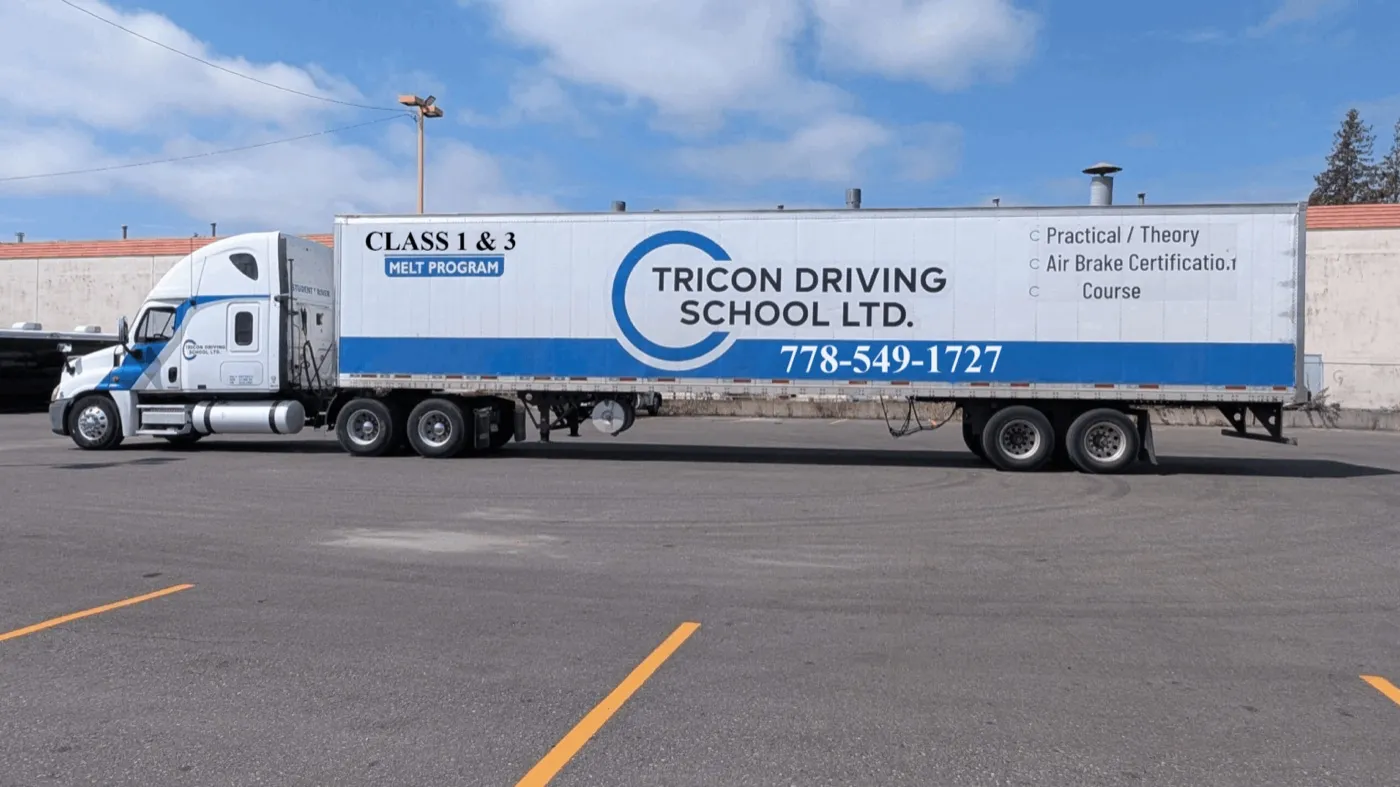
Class 1 licenses you to drive a tractor-trailer — an articulated combination unit, connected by a fifth wheel — and requires British Columbia's 140-hour Mandatory Entry-Level Training (MELT) course before you can even book the road test. Class 3 licenses you to drive a straight truck — a single vehicle, not a combination — such as a dump truck, hydro truck, or a tandem-axle delivery or construction truck, and carries no ICBC-mandated minimum hour count.
Both sit above a Class 5, and both typically involve air brakes. But they cover genuinely different vehicles and lead to different kinds of work. Class 1 is the licence for pulling a trailer, with training built around highway and mountain driving assessments. Class 3 is the licence for driving a bigger single truck than a car licence allows, and a Class 3 also carries every privilege of a Class 5 plus the ability to tow a trailer over 4,600 kg.
Not sure which vehicle you'll actually be driving?
The fastest way to know which licence you need is to look at the vehicle itself. If it connects to what you're hauling with a fifth wheel, that's Class 1 territory. If it's one vehicle with everything built onto it — a dump box, hydro equipment — that's Class 3. Call us at (778) 549-1727 and we'll talk through the actual job before you commit to either.
Class 1, at a glance
- A tractor and semi-trailer or B-train combination with a loaded weight of at least 32,000 kg, minimum tandem axles and a sliding fifth wheel.
- A trailer at least 14.63 m (48 ft) long, with a full air brake system on both tractor and trailer.
- Mandatory 140-hour MELT course, required by law for any first B.C. Class 1 licence.
Class 3, at a glance
- Any single (non-articulated) truck with more than two axles or a heavy gross vehicle weight rating — dump trucks, hydro trucks, tandem-axle delivery and construction trucks.
- Everything already covered by a Class 5, plus towing a trailer over 4,600 kg.
- No fixed MELT-style hour count — training is paced to what you can already do behind the wheel.
Side-by-side comparison
Every fact below is pulled directly from Tricon's own Class 1 and Class 3 course pages — nothing here is estimated.
| Class 1 (tractor-trailer) | Class 3 (straight truck) | |
|---|---|---|
| Vehicle type | Articulated combination — tractor and semi-trailer or B-train, connected by a fifth wheel | Single (non-articulated) truck with more than two axles or a heavy GVW rating |
| Typical vehicles | Highway tractor-trailers, B-trains, long combinations | Dump trucks, hydro trucks, tandem-axle delivery and construction trucks |
| Training standard | ICBC Mandatory Entry-Level Training (MELT) — a fixed, province-wide curriculum | No ICBC-mandated curriculum — Tricon assesses and paces each student individually |
| Minimum training hours | 140 hours (47 theory + 93 practical: 19 in-yard, 18 off-road, 50 on-road, 6 flexible) | No ICBC-set minimum — depends on your existing experience |
| Air brake training | Built into MELT as module 10 — 9 hours theory + 6.5 hours practical (15.5 hours total) | Included where the vehicle has air brakes (almost all Class 3 vehicles do), with its own knowledge test |
| Minimum age | 19 | 18 |
| Licence prerequisite | Full-privilege B.C. Class 5 or 6 (a Class 7 novice licence doesn't qualify) | Full-privilege B.C. Class 5 or 6 (a Class 7 novice licence doesn't qualify) |
| Knowledge test | Class 1 knowledge test — 60 questions, 48 to pass, air brake questions included + road signs test | Class 3 knowledge test — 35 questions, 28 to pass — + road signs test, plus a separate air brake test if applicable |
| Medical requirement | Driver's Medical Examination Report (DMER) to the commercial standard | DMER to the commercial standard, plus a vision test |
| Course timeline | Can't finish in fewer than 30 days; must finish within 365 days of enrolment | No ICBC-set floor or ceiling |
| Road test | Pre-trip inspection including air brakes, then the on-road drive, in a tractor-trailer combination | Pre-trip inspection (including air brakes, if applicable), then the on-road drive, in a Class 3 vehicle |
| Typical work | Highway and mountain driving, pulling loaded trailers over longer routes | Local and regional driving — construction, hydro and municipal work that keeps you closer to home |
Want the full 140-hour MELT breakdown?
This table covers the headline differences. For the module-by-module curriculum behind Class 1's 140 hours, see our dedicated What Is MELT? guide.
Which one is right for you?
There's no universally "better" licence — the right one depends on the vehicle you'll actually be driving and the kind of work you want.
Class 1 fits you if…
You want to drive a tractor-trailer combination — highway and mountain driving, pulling a loaded trailer over longer distances. You're comfortable committing to the full 140-hour MELT course, six practical and three written assessments, and you're at least 19.
Class 3 fits you if…
You want to drive a single heavy vehicle — a dump truck, hydro truck, or construction or municipal truck — for local or regional work that keeps you closer to home. You're at least 18 and want training paced to your own experience rather than a fixed hour count.
Already have a specific job offer on the table? The vehicle the employer actually puts you in decides which licence you need, not the other way around. Call us at (778) 549-1727 and describe the truck — we'll tell you straight which licence it requires.
Still not sure which one?
Tell us about the job or the vehicle and we'll point you at the right course — no obligation, no sales pitch.
Can I get both — or upgrade later?
Yes — Class 1 and Class 3 are separate ICBC licensing processes, each with its own knowledge test, learner's licence and road test, so there's nothing stopping you from holding both over time. Many students start with whichever licence matches their immediate goal — a job offer that needs a Class 3 now, say — and pursue the other licence later once it makes sense for them.
One thing worth knowing if Class 1 is somewhere in your future: holding a Class 3 licence doesn't reduce or exempt you from the full 140-hour MELT course when you move up to Class 1. Commercial licence holders moving up earn no advanced standing toward MELT — the 140 hours apply in full, the same as they would for a driver starting from a Class 5.
Class 1 vs Class 3 — frequently asked questions
Which is easier to get, Class 1 or Class 3?
Neither is simply "easier" — they're built differently. Class 1 has a fixed, ICBC-mandated curriculum: 140 hours of Mandatory Entry-Level Training, six practical and three written assessments, each passed twice, before you're issued a Declaration of Completion. Class 3 has no ICBC-set minimum hour count and a lower minimum age (18 versus 19), with training paced to how much experience you already have — but you're still learning a larger vehicle than a car licence covers, plus the air brake system most Class 3 trucks carry.
Can I go straight for Class 1 without getting Class 3 first?
Yes. Class 3 is not a required stepping stone to Class 1. To start Class 1 MELT you need a full-privilege B.C. Class 5 or 6 licence, to be at least 19, to pass the Class 1 knowledge and road signs tests, hold a Class 1 learner's licence, and meet the commercial medical standard.
Already holding a Class 3 licence doesn't reduce or exempt you from the full 140-hour MELT course either — commercial licence holders moving up to Class 1 earn no advanced standing.
Which pays more, Class 1 or Class 3?
That depends on the employer, route and region rather than the licence class alone, so we won't put a number on it here. Our truck driver salary guide looks at that question in detail.
Does Class 3 include air brake training?
Almost always, yes. Most Class 3 vehicles are equipped with air brakes, so most Class 3 drivers need the endorsement — you'll add the air brake knowledge test to your Class 3 knowledge test and complete an air brake pre-trip inspection test on a single-unit vehicle. Tricon builds this into Class 3 training rather than selling it separately; see our standalone air brake course if you already hold Class 3 and only need the endorsement.
Do I need MELT for Class 3?
No. Mandatory Entry-Level Training applies only to a first B.C. Class 1 licence. There's no ICBC-mandated minimum number of training hours for Class 3 — training is paced to the individual student instead. See our What Is MELT? guide for the full Class 1 picture.
What's the minimum age for Class 1 versus Class 3?
Class 1 requires you to be at least 19. Class 3 requires you to be at least 18 — a year younger. Both also require a full-privilege B.C. Class 5 or 6 licence; a Class 7 novice licence doesn't qualify for either.
Can I train for both Class 1 and Class 3 at Tricon?
Yes. Tricon runs both programs from the same Surrey and Langley yards. Many students start with whichever licence matches their immediate goal and pursue the other one later, since Class 1 and Class 3 are separate ICBC processes each with their own knowledge test, learner's licence and road test.