
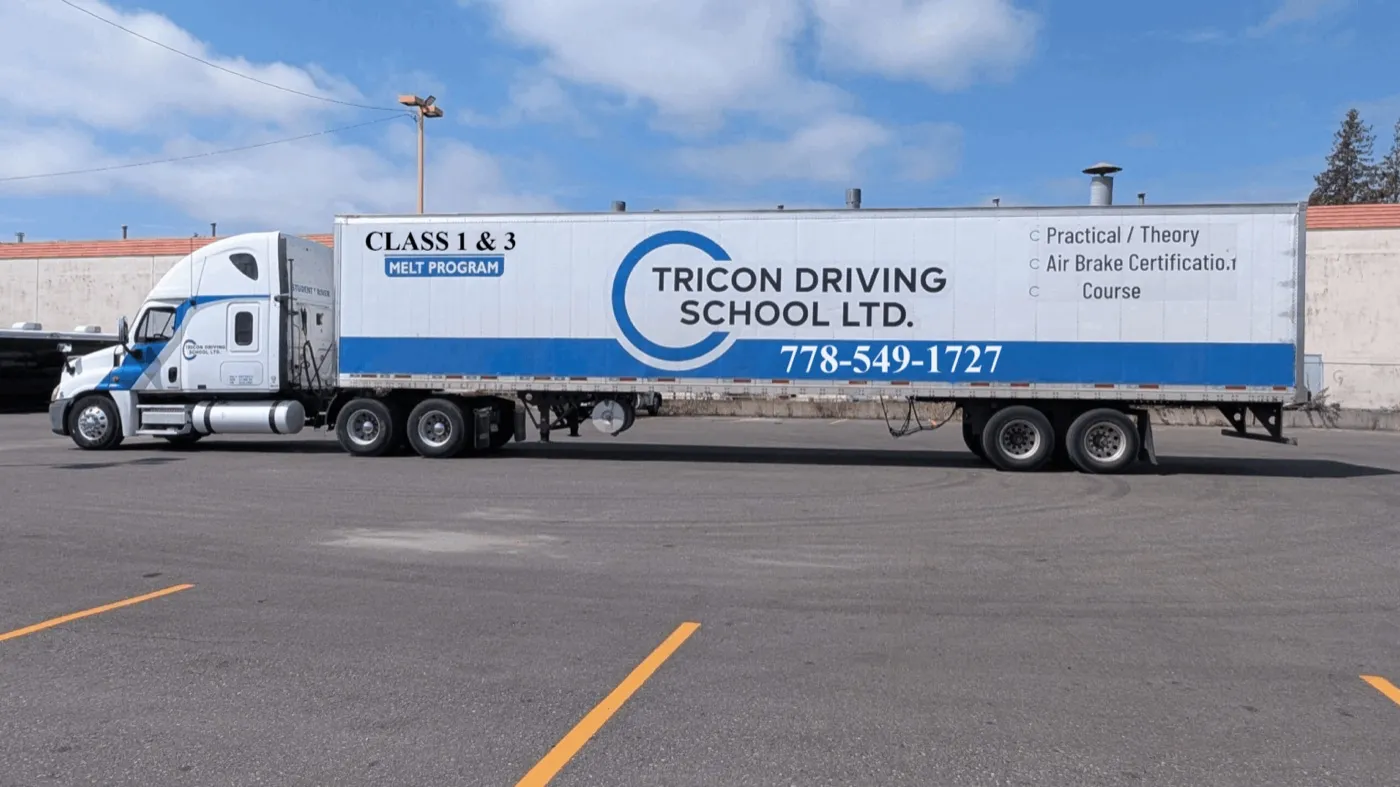
What a Class 1 licence lets you drive
A Class 1 is the top commercial driver’s licence in British Columbia. It permits you to drive any motor vehicle or combination of vehicles — most importantly a tractor-trailer, the semi you see on the Coquihalla — and it carries every lower class with it, so a Class 1 holder can also drive Class 2, 3, 4 and 5 vehicles.
In practice, almost every Class 1 also carries an air brake endorsement (Code 15), because virtually all heavy commercial equipment in Canada runs air brakes. The two go together so consistently that B.C. folds the air brake knowledge questions into the Class 1 knowledge test itself.
Getting there is a defined, government-regulated sequence. It is not complicated, but the steps have to happen in the right order — and one of them in particular trips people up badly if they get it wrong. This guide walks through all of it.
The one thing not to get wrong
You must hold a Class 1 learner’s licence before you enrol in training. Hours taken before you have it do not count toward your MELT requirement, and no school can retroactively credit them.
The process, start to finish
Here is the whole sequence at a glance. Each step is expanded below.
-
Confirm you’re eligible
Age, licence class, driving record, medical fitness and anything owed to ICBC.
-
Complete your medical
A Driver’s Medical Examination Report completed by your physician.
With your doctor -
Pass the knowledge tests
Class 1 knowledge — which includes the air brake questions in B.C. — plus road signs.
At an ICBC office -
Get your Class 1 learner’s licence
Your legal permission to drive a training truck on the road. Required before enrolling.
At an ICBC office -
Complete the 140-hour MELT course
47 hours theory, 93 hours practical, six practical and three written assessments, and your MV2970 Declaration of Completion at the end.
With a school like us -
Pass the ICBC Class 1 road test
Pre-trip inspection including air brakes, then the drive. Pass, and the licence is yours.
At an ICBC office
Step 1 — Are you eligible?
Before anything else, check yourself against this list. Everything here is decided by ICBC on your record, not by a school.
- Be at least 19 years old. That is the minimum age for a Class 1, 2 or 4 licence in British Columbia.
- Hold a full-privilege B.C. Class 5 or 6 licence, or an accepted out-of-province equivalent. A Class 7 novice licence is not enough — you must be out of the graduated licensing program.
- Meet the commercial medical standard. You declare any conditions up front and complete a Driver’s Medical Examination Report with your physician.
- Have a clean enough driving record. Fewer than four penalty-point incidents in the past two years, and no driving-related criminal convictions in the past three.
- Owe ICBC nothing. Outstanding fines or debts to ICBC will stop the process before it starts.
- Be legally entitled to work or reside in Canada as required for licensing purposes.
Do you need MELT at all?
Mandatory Entry-Level Training has been the law in British Columbia since 18 October 2021. It applies to:
- Anyone applying for their first Class 1 licence in Canada.
- Drivers who have held a Canadian Class 1 licence for less than 12 months.
- Anyone whose Class 1 licence and training come from outside Canada, regardless of how many years they have driven. No credit is given for foreign training or experience.
- Holders of a B.C. Class 2, 3 or 4 licence moving up to Class 1 — an existing commercial licence earns no advanced standing.
Who may be exempt
- Your B.C. Class 1 licence expired less than three years ago and you are still eligible to renew it.
- You have held a valid Canadian Class 1 licence for 24 consecutive months or more within the past three years.
- You completed a full MELT course in Alberta, Ontario, Saskatchewan, Manitoba, Newfoundland and Labrador, the Northwest Territories or New Brunswick. Ontario Class A graduates with under 24 months’ experience still owe B.C. the air brake portion.
Exemptions are decided by ICBC on your driving record. If you think one might apply to you, confirm it before you pay for anything — it is a five-minute phone call and it is free.
Step 2 — The medical
Commercial licence classes carry a medical standard that an ordinary Class 5 does not. You declare any relevant conditions when you apply, and you complete a Driver’s Medical Examination Report (DMER) with your physician.
The examination covers vision, hearing, cardiovascular health, neurological conditions, diabetes management, sleep disorders and anything else that could affect your ability to safely operate a heavy vehicle. Your doctor completes the form; ICBC assesses it.
If you have a condition you are uncertain about, do this early rather than late. You can ask ICBC for a Class 1 DMER before you commit to a course — which is a great deal better than discovering a problem after you have paid tuition. Commercial drivers also re-certify medically on a recurring schedule throughout their career.
Step 3 — The knowledge tests
Two tests at an ICBC driver licensing office: the Class 1 knowledge test and the road signs test.
Air brakes are on the same test
In British Columbia the Class 1 and air brake knowledge questions are combined into a single test. Study the air brake chapters of the commercial driving guide properly, and study them early — not the night before. This is the most common reason for a failed first attempt.
What to study
- ICBC’s Driving Commercial Vehicles guide — the core text for the Class 1 knowledge test.
- The Air Brake Manual — system components, inspection procedure, pushrod travel, leakage limits and the low-air warning.
- Road signs, signals and pavement markings.
- Hours of service rules, cargo securement basics and vehicle inspection requirements.
- ICBC’s free online practice tests. Take them until you are bored of passing them — they are the closest thing to the real test you will find.
Step 4 — Your Class 1 learner’s licence
Pass the knowledge tests and ICBC issues your Class 1 learner’s licence. This is the document that makes it legal for you to drive a training truck on a public road with a qualified instructor beside you.
It is also the gate on your training. You must hold it before you enrol in MELT. Any hours taken before it exists do not count, cannot be backdated, and will not appear on your ICBC attendance record. Every experienced school in the province will refuse to start you without it, and if one offers to, that tells you something.
Not sure which step you're on?
Tell us what's on your licence today and we'll map out exactly what's left — no obligation, no sales pitch.
Step 5 — The 140-hour MELT course
Mandatory Entry-Level Training is the standardised course every new Class 1 driver in B.C. must complete before ICBC will allow a Class 1 road test attempt. The curriculum was built on National Safety Code Standard 16 and then adapted for the province — and B.C.’s version is deliberately heavier than the national floor in two places: air brakes and mountain driving.
How the 93 practical hours break down
| Component | Hours | What it covers |
|---|---|---|
| In-yard | 19 | Vehicle systems, pre-trip inspection, coupling and uncoupling, air brake checks |
| Off-road manoeuvres | 18 | Straight-line, offset and alley-dock backing; low-speed control |
| On-road driving | 50 | Urban, rural and highway driving, including mountain grade |
| Flexible practical | 6 | Mandatory additional time directed at whatever you personally need |
| Total practical | 93 | Plus 47 hours of theory for the full 140 |
The calendar rules
- The course cannot be completed in fewer than 30 days. There is no legitimate fast-track, and a school offering one is not following the standard.
- It must be finished within 365 days of your enrolment date.
- Most students finish in four to eight weeks, depending on how many days a week they can commit.
- Every hour is logged against your name on an ICBC attendance form.
The assessments
MELT is not an attendance exercise. You must pass six practical assessments — highway and mountain driving, pre-trip inspection including air brakes, coupling and uncoupling, chain-up and slides, backing, and basic and urban driving — plus at least three written assessments at a minimum overall mark of 80%. Each must be passed twice.
When you finish, the school issues your MV2970 Class 1 MELT Declaration of Completion and files a copy with ICBC. Keep your student copy. Without it on file, you cannot sit the road test.
For the full module-by-module breakdown, see our Class 1 MELT course page.
Manual or automatic — the decision that follows you
You will be asked, early, whether you want to train and test in a manual or an automatic truck. It is presented as a preference. It is actually a career decision, and it deserves more thought than most students give it.
If you take your road test in an automatic, ICBC applies a restriction to your licence. You are then limited to automatic or semi-automatic equipment. Any employer whose fleet includes manual trucks — which in British Columbia still means a great deal of the flat deck, logging, gravel and older highway work — cannot hire you for those units.
An automatic licence is not a mistake if you know which employers you are aiming at, and plenty of modern highway fleets are fully automatic. It becomes a mistake when nobody explains the trade-off before you choose. Ask any school you speak to, including us, to be straight with you about which doors it closes.
If you want the manual and are unsure about the shift itself, see our manual transmission training page for how a 13-speed is actually taught. If you're deliberately weighing the automatic route, our Class 1 automatic transmission training page lays out exactly what the restriction covers, who it suits, and how to retest for a full licence later.
Step 6 — The ICBC Class 1 road test
The final gate. You can book the test before you finish your course — and given wait times, booking ahead is often sensible — but you cannot sit it until ICBC has your Declaration of Completion on file.
What the test covers
- A pre-trip inspection, out loud. You walk the combination and describe what you are checking and why. Include the air brake system.
- The air brake practical. Applied and released pushrod travel, leakage tests, low-air warning, and the governor cut-in and cut-out.
- Coupling and uncoupling. Performed methodically, with the safety checks in the right order.
- Backing manoeuvres. Straight-line, offset and alley dock, using your mirrors and getting out to look when you should.
- The road drive. Urban and highway, covering lane management, space and speed, intersections, turns, gear selection and hazard awareness.
The pre-trip is where tests are lost
More Class 1 candidates fail on the pre-trip inspection than on the drive. It is pure preparation — a memorised, methodical, spoken routine — which makes it the most controllable part of the whole test. Drill it until it is boring.
If you do not pass, you rebook and try again. ICBC charges for each attempt and there is normally a minimum wait between them. Most failures come down to one specific weakness, and a few hours of individual instruction aimed squarely at it is usually far more effective than repeating the whole course.
After you pass
Your full-privilege Class 1 licence is issued, with any endorsements and restriction codes applied. A few things to understand about the licence you now hold:
- Code 15 on your licence is the air brake endorsement. In practice you need it for essentially all Class 1 work.
- A restriction code will appear if you tested in an automatic. It limits the equipment you can legally drive.
- Your driving record now matters commercially. Your ICBC abstract is the first thing a carrier looks at. Tickets and at-fault claims carry far more weight than they did before.
- You are subject to the National Safety Code. Hours of service, logbooks, inspection reports and cargo securement are now part of your working day.
- Medical re-certification continues. Commercial classes require periodic medical review for as long as you hold them.
- Your first job is a stepping stone. Twelve clean months changes what you are worth. See job placement for how the B.C. hiring market actually works.
How long it all takes
A realistic timeline for someone starting from a full Class 5 licence. Individual results vary with ICBC appointment availability, which fluctuates.
| Stage | Typical time | Notes |
|---|---|---|
| Studying for the knowledge test | 1–3 weeks | Depends entirely on you. Air brake chapters take the longest. |
| Knowledge test & learner’s licence | Same day | Subject to ICBC office availability. |
| Medical (DMER) | 1–3 weeks | Driven by your physician’s availability. Start it early. |
| MELT course | 4–8 weeks | Regulated minimum of 30 days; maximum of 365. |
| Waiting for a road test | Varies | Book early. Wait times move with demand. |
| Total | 2–4 months | For a student able to train several days a week. |
What it costs
There are two separate cost buckets, and confusing them is the most common budgeting mistake new commercial drivers make.
Your training course
Paid to an ICBC-approved school. This is the larger figure, and it varies with the programme you need, what you already hold, and how much individual instruction you want. See course fees.
ICBC’s own fees
Knowledge tests, the learner’s licence, the road test and licence issuance are paid to ICBC directly. Current amounts are published on ICBC’s site.
Your medical
What your physician charges to complete the DMER is between you and them.
Retests, if needed
ICBC charges per road test attempt. Good preparation is considerably cheaper than a second attempt.
Funding is widely available
British Columbia has a driver shortage it actively wants filled, and it funds training accordingly. The B.C. Employer Training Grant can cover up to 80% of eligible costs to a maximum of $10,000 per participant where an employer sponsors you, and several provincial programs target people entering in-demand occupations. Many schools, ourselves included, also offer in-house payment arrangements. See funding options.
Where people get stuck
After enough years of this, the same handful of avoidable problems come up again and again. None of them are complicated. All of them cost time and money.
- Booking training before holding the Class 1 learner’s licence. Hours taken before you hold it do not count toward MELT. This is the single most expensive mistake we see.
- Leaving the air brake chapters until last. In B.C. the Class 1 and air brake knowledge questions are on one test. Students who skim the air brake material fail the whole thing.
- Underestimating the pre-trip. More Class 1 road tests are lost on the pre-trip inspection than on the drive. It is pure preparation, and it is entirely within your control.
- Choosing automatic without understanding the restriction. Test in an automatic and ICBC restricts your licence, closing off employers whose fleets include manual equipment.
- Assuming foreign experience counts. It does not, for licensing. Twenty years driving abroad still means the full 140 hours in British Columbia.
- Not clearing outstanding fines first. Money owed to ICBC will halt your application at the counter.
- Picking a school on headline price alone. Ask what is included, how many students share a truck, and which highway they use for mountain training. See course fees.
Class 1 licensing in BC — frequently asked questions
How long does it take to get a Class 1 licence in BC?
Realistically, two to four months from starting the process to holding the licence. The MELT course itself cannot be completed in fewer than 30 days by regulation, and must be finished within 365 days of enrolment.
Most students take somewhere between four and eight weeks over the course, depending on how many days a week they can commit. Add time before that for the knowledge test and learner's licence, and after it for booking and sitting the ICBC road test.
How old do you have to be to get a Class 1 in BC?
19. That is the minimum age for a Class 1, 2 or 4 licence in British Columbia. You must also already hold a full-privilege Class 5 or 6 licence — a Class 7 novice licence is not sufficient.
Do I need MELT if I already have a Class 3 licence?
Yes. Holding a B.C. Class 2, 3 or 4 licence earns no advanced standing toward Class 1. You complete the full 140-hour MELT course like any other applicant.
Your existing commercial experience will make the course easier, but it does not shorten it.
Can I get a Class 1 licence with an automatic transmission?
You can, but ICBC will apply a restriction to your licence limiting you to automatic or semi-automatic equipment. That restriction closes the door on any employer whose fleet includes manual trucks — which in B.C. still covers a lot of flat deck, logging, gravel and older highway fleets.
It is a legitimate choice if you know which employers you are aiming at. It becomes a problem when nobody explained the trade-off first. Call us and we will be straight with you about it.
How much does it cost to get a Class 1 licence in BC?
There are two separate costs: your training course, paid to a school, and ICBC's own fees for knowledge tests, the learner's licence, the road test and licence issuance. ICBC publishes its current fees on its own site.
On the training side, we quote by phone because what you pay depends on which programme you need, what you already hold, and which funding you qualify for. See course fees, or call (778) 549-1727 for a figure that fits your situation.
Is the air brake endorsement included in Class 1 training?
Air brake training is part of the Class 1 MELT curriculum, so yes — it is included in a Class 1 course. The air brake knowledge questions are also part of the same Class 1 knowledge test in B.C.
If you only need the endorsement on its own, that is a separate and much shorter air brake course.
What happens if I fail the Class 1 road test?
You rebook and try again. ICBC charges for each attempt, and there is normally a minimum waiting period between them.
The more useful question is why. Most failures come down to the pre-trip inspection or one specific manoeuvre, both of which respond very well to a few hours of focused instruction. That is what individual lessons exist for.
I have driven trucks for years in another country. Do I still need MELT?
Almost certainly yes. ICBC gives no credit for commercial training or experience obtained outside Canada. You will need a full-privilege B.C. Class 5 or 6 licence first, then the complete 140-hour MELT course.
It is a genuinely frustrating rule for experienced drivers. The one thing worth saying is that once you hold the B.C. licence, those years become a real advantage with employers. Call us before you spend anything and we will map out exactly which steps apply to you.
Can I book my road test before finishing the MELT course?
Yes, you can book it — but you cannot sit it until ICBC has your MV2970 Declaration of Completion on file. Because road test wait times can be long, booking ahead while you finish the course is often sensible.
Do I need a medical to get a Class 1?
Yes. Commercial licence classes require you to meet a medical standard, evidenced by a Driver's Medical Examination Report completed by your physician. If you are unsure about your fitness, you can request a Class 1 DMER from ICBC before you commit to a course.