
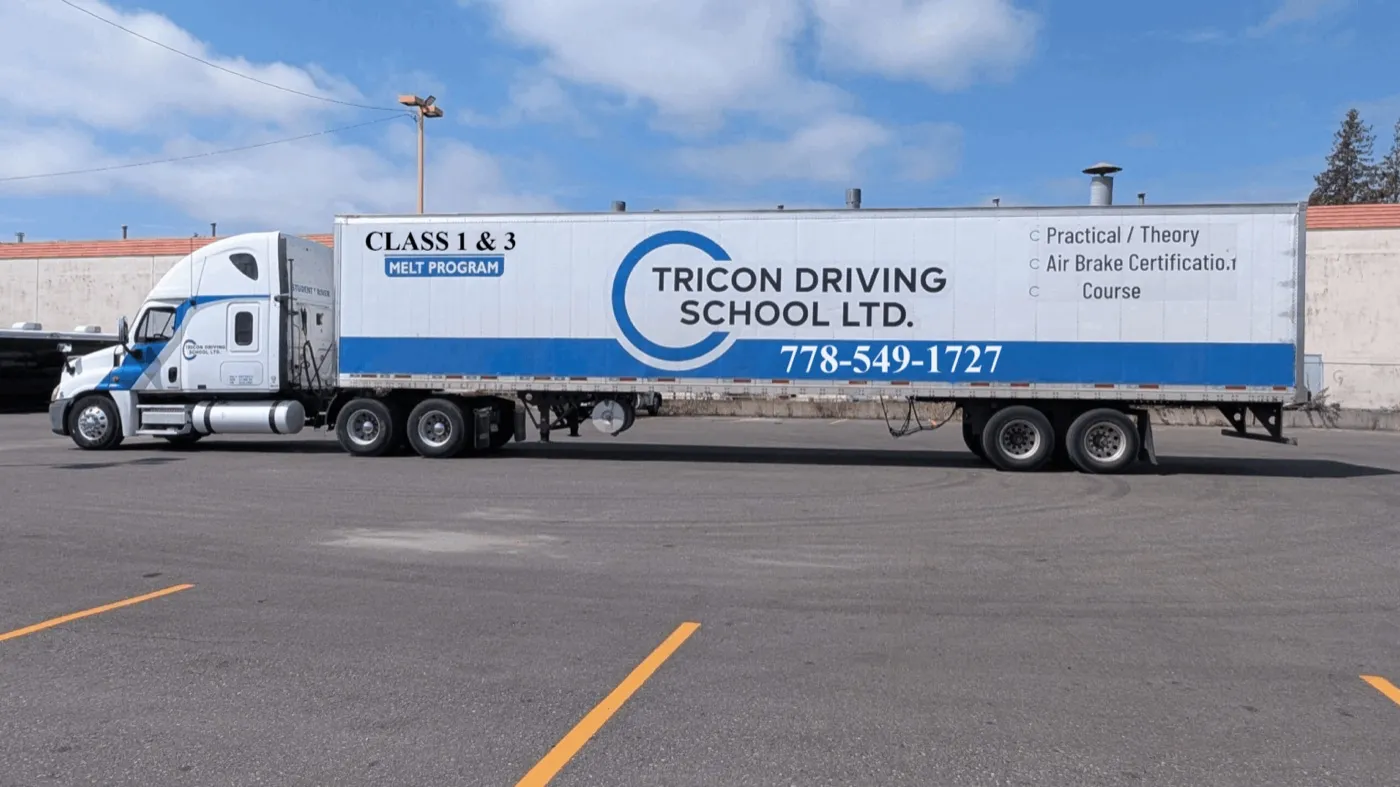
01. The Golden Rules of Commercial Truck Backing
Every commercial backing incident is preventable. Whether backing a 53-foot dry van into a Fraser Valley distribution dock or steering a tandem-axle dump truck down a gravel access lane, professional drivers execute the same foundational habits before shifting into reverse.
Backing accidents account for more than 30% of commercial vehicle insurance claims in Canada, yet fewer than 1% of total driven kilometres are spent in reverse. The human eye has no direct rear visibility in a commercial cab; all spatial awareness depends on mirrors, planning, and getting out of the cab.
The G.O.A.L. Standard: Get Out And Look
Never rely solely on mirrors when entering a blind space or tight dock. Set the tractor parking brake, shift to neutral, put on your high-visibility vest, step out of the cab, and walk the entire perimeter of your planned backing path. Verify overhead clearance (sprinkler lines, canopies, wires), ground obstacles (curbs, wheel chocks, pallets), and pedestrian paths before beginning.
-
Idle speed only: Backing must be conducted at idle crawl (1–2 km/h) with your foot hovering over the service brake pedal. Speed eliminates reaction time and magnifies small steering mistakes into jackknifes.
-
4-Way Flashers & Window Down: Always activate 4-way hazard flashers before moving in reverse. Lower your driver-side window so you can hear horns, spotters shouting, reverse alarms, or unexpected crunching sounds.
-
Continuous mirror scanning: Never fixate on one mirror. Divide your focus rhythmically: left flat mirror → left convex → right flat mirror → right convex → front steer axle tracking.
-
The bottom-of-the-wheel technique: When backing a trailer, place your hand at the 6 o'clock position on the steering wheel. If you want the rear of the trailer to move left, push your hand to the left. If you want it to move right, push right. This eliminates mental inversion errors.
02. ICBC Commercial Road Test Requirements & Scoring
Before an ICBC driver examiner takes you onto public roads and highways, you must demonstrate basic vehicle control in the test yard. The yard backing maneuvers test whether you have master command of your vehicle dimensions, mirror geometry, and spatial judgment.
ICBC test yards throughout Metro Vancouver and the Fraser Valley (such as Surrey, Langley, Richmond, and Abbotsford) set up standardized cone layouts. During the test, the examiner stands outside the vehicle observing your approach, steering input, mirror checks, and boundary discipline.
ICBC Scoring Criteria: What Examiners Look For
-
Pre-movement check: Engaging 4-ways, sounding the horn if required by site rules, adjusting mirrors properly, and doing a full 360-degree head check before rolling.
-
Smooth vehicle control: Maintaining steady low-speed idle without stalling the engine, lurching, or locking wheels.
-
Boundary maintenance: Keeping all trailer tires and tractor body components strictly inside the cone alley and boundary lines.
-
Final alignment & dock depth: Bringing the vehicle to a full stop within the target box, perfectly centred between boundaries, and applying the parking brakes.
The Pull-Up Rule on ICBC Road Tests
Pull-ups are a legal and expected tool for commercial drivers. If your trailer begins drifting off course, pulling forward 15 to 20 feet to straighten your tractor and trailer is considered safe, professional practice. However, uncalculated pull-ups caused by panic, running over cones, or needing more than the examiner's allowable limit will result in points deducted or test failure.
03. Straight-Line Backing: Step-by-Step
Straight-line backing sounds deceptively simple, but it is the foundation of all trailer control. The objective is to reverse a commercial vehicle 100 feet down a narrow 12-foot lane without touching either boundary line.
Because an articulated trailer is inherently unstable when pushed from behind, the trailer will naturally attempt to deviate left or right. The secret is making micro-corrections early rather than large corrections late.
The Initial Setup
Pull forward completely straight through the alley until your tractor and trailer are in a dead-straight line. Equalize your mirrors: you should see identical thin slivers of your trailer side rails in both flat mirrors.
The Micro-Correction
As you crawl in reverse, watch your flat mirrors. If more trailer begins appearing in your right mirror, the rear is drifting left. Turn the steering wheel slightly right (toward the mirror showing too much trailer) to push it back into center.
The Immediate Chase
As soon as the trailer starts straightening, counter-steer back to center immediately. If you wait until the trailer is straight before centering the wheel, the trailer will overshoot and drift into the opposite boundary.
The 12-to-1 Steering Limit
Never turn your steering wheel past 10 o'clock or 2 o'clock during straight-line backing. Moving the wheel more than a quarter turn will rapidly jackknife a 53-foot trailer in a 12-foot cone alley.
04. Offset Backing: Left & Right Lanes
Offset backing simulates shifting your truck and trailer from one lane into an adjacent parallel lane while traveling in reverse. ICBC tests both Offset Left and Offset Right.
In this maneuver, your vehicle starts in Lane A and must finish cleanly positioned inside Lane B (12 feet to the side), stopping inside a 40-foot box at the rear of the lane.
The 3 Phases of Offset Backing
-
Phase 1: The Break (Initiating Articulation): Shift into reverse, check your mirrors, and steer hard to create an angle between tractor and trailer. For Offset Left, steer right to send the trailer left into the opening. Establish an articulation angle of approximately 15 to 20 degrees.
-
Phase 2: The Drift (Crossing the Gap): Once the trailer points directly into the mouth of the target lane, counter-steer back across center to follow the trailer and hold that diagonal drift. Maintain your eyes on the trailer rear tandems as they cross the boundary threshold.
-
Phase 3: The Chase & Finish: As the rear trailer tires cross into Lane B, hard steer to bring the tractor in front of the trailer and straighten the whole combination. If your tractor remains angled when entering the lane, take an immediate, planned pull-up straight forward to reset before backing into the final stop position.
05. 90° Alley Dock: Setup, Drift & Chase
The 90-degree alley dock is the pinnacle of commercial vehicle yard testing and the maneuver most frequently encountered at distribution centres and warehouse docks throughout the Lower Mainland.
You must maneuver a combination vehicle from a roadway or alleyway perpendicular into a 12-foot wide dock slip, bordered by simulated vehicles or boundary cones on both sides.
Step-by-Step 90° Alley Dock Technique
-
The 45° Setup (The Pull-Out): Drive parallel to the dock line at a distance of 10 to 12 feet. As your drive axle passes the center of the target dock, steer sharply away from the dock at a 45-degree angle, then counter-steer to align the tractor in front of the trailer. This points your trailer rear directly toward the target slot.
-
Pivot Around the Driver-Side Cone: Shift into reverse, check all sides, and steer to pivot the trailer around the near cone (Cone A). Keep your rear trailer tires approximately 3 feet off this pivot cone. If you hug this cone closely on your sight-side, you guarantee clearance on the blind side.
-
Chase the Trailer into the Slot: As the trailer enters the dock boundaries, steer aggressively under the trailer to straighten the tractor. Do not wait until the tractor is inside the lane; begin chasing while the tractor is still swinging.
-
Perform G.O.A.L. Before Final Contact: Stop 10 to 15 feet before reaching the dock bumper or cone line. Set the brakes, exit the cab, and inspect the distance to the dock pads. Re-enter and feather the brakes to stop within the 18 to 24-inch target zone.
06. Class 1 (Tractor-Trailer) vs. Class 3 (Straight Truck Tail-Swing)
One of the most dangerous misconceptions among commercial students is assuming that straight trucks (Class 3) and articulated tractor-trailers (Class 1) back up the same way. Their steering geometry and collision risks are fundamentally opposite.
| Handling Parameter | Class 1 (Tractor-Trailer) | Class 3 (Straight Heavy Truck) |
|---|---|---|
| Articulation Point | Pivots at the 5th wheel kingpin. Two separate rigid bodies. | Single rigid frame. No articulation point. |
| Initial Steering Direction | Opposite: Turn steering wheel right → trailer moves left. | Direct: Turn steering wheel left → rear of truck moves left (like a passenger car). |
| Steering Delay (Lag Time) | Significant: 1 to 2 truck lengths before trailer reacts to wheel input. | Instantaneous: Vehicle reacts immediately upon tire rotation. |
| Greatest Collision Risk | Jackknife damage, blind-side trailer drift, running over curb cones. | Rear Tail-Swing: Overhang swinging outward into adjacent vehicles or warehouse walls. |
| Recovery Technique | Pull forward 20 feet to reset kingpin angle in line with tractor. | Simple forward pull-up to straighten wheels and re-center. |
Understanding Tail-Swing on Class 3 Straight Trucks
A Class 3 dump truck, concrete mixer, or 26-foot box truck has a large overhang behind the rear drive axles. When you are backing up and turn your steering wheel sharply to the right (to back into a dock on your right), the rear wheels act as a fulcrum: the tail of the truck swings outward to the left.
In a tight warehouse yard, this tail-swing can strike parked vehicles, light posts, or warehouse bollards located on the side opposite your turn. Professional Class 3 drivers constantly monitor both the direction of travel and the opposite tail-swing sweep.
07. Real-World Warehouse & Loading Dock Backing
Backing into a real commercial loading dock is significantly different from backing between plastic yard cones. You are dealing with active forklift traffic, tight staging lots, overhead door seals, and irregular dock heights.
Sight-Side vs. Blind-Side
Always loop around the yard to set up a sight-side backing approach (driver side). Sight-side allows you to lean out the window and maintain direct line-of-sight with your trailer tires. Never perform a blind-side back unless site architecture offers zero alternative.
Dock Seals & Cushions
Back squarely against dock seals. If you approach at an angle, the rear corner of the trailer can crush the rubber shelter or rip the door curtains. Stop 2 feet away, open your swing doors, latch them flush against the trailer sides, and finish backing slowly into the rubber cushions.
Trailer Restraints & Chocks
Once your ICC bumper contacts the dock pads, set the trailer air brakes and verify that the warehouse Dok-Lok automatic restraint has engaged the rear bumper. If no automated restraint exists, place heavy rubber wheel chocks under the rear drive tires before forklift loading begins.
Air Suspension Dump Valve
Many modern trailers and tractors have a suspension air dump valve. Dumping trailer suspension air lowers the deck slightly before entering tight dock shelters and prevents the trailer from rising and jamming against the overhead canopy during unloading.
08. Common Backing Mistakes & How to Recover
Even experienced commercial drivers encounter moments when a backing maneuver gets out of control. Knowing how to diagnose and recover from an error immediately is what separates professionals from novices.
-
Mistake #1: Over-steering: Turning the steering wheel too far and too fast. This creates an unrecoverable jackknife angle before you have time to counter-steer. Recovery: Do not attempt to reverse your way out of an over-steered jackknife. Stop, shift into forward gear, pull forward 20 feet to straighten the combination, and restart with gentle quarter-turns.
-
Mistake #2: Tunnel vision on the rear: Focusing 100% of your attention on the trailer rear tandems and forgetting about the front tractor fenders. When you turn sharp in reverse, the tractor front swings wide in a huge arc. Recovery: Always alternate mirror checks with looking forward out the windshield to verify your steer tires aren't sweeping into fences, posts, or adjacent cabs.
-
Mistake #3: Reluctance to pull up: Letting pride prevent you from pulling forward when you are crooked. Struggling in reverse usually results in a worse angle or hitting a cone. Recovery: Take the pull-up! A controlled pull-up is scored favourably on the ICBC road test as a sign of professional judgment.
Want 1-on-1 Yard Backing Practice?
Tricon operates dedicated commercial training yards in Surrey and Langley with full ICBC cone alleys, offset bays, and simulated loading dock slips. Practice under professional instructor coaching until backing becomes second nature.
09. Frequently Asked Questions
Clear, direct answers to the most common questions our commercial driving instructors receive about ICBC backing testing and yard procedures.
How many pull-ups are allowed during the ICBC yard backing test?
On the ICBC commercial road test yard assessment, pull-ups are permitted to realign your combination. Examiners evaluate vehicle control and safety judgment: an intentional, planned pull-up to correct trailer alignment without striking cones or exceeding boundary lines is scored as safe driving. However, excessive repeated pull-ups or losing control of the unit will result in penalty points or a test failure.
What is the difference between sight-side and blind-side backing?
Sight-side backing curves the trailer toward the driver's left side, allowing the driver to look directly out the driver's window and keep the rear of the trailer in the flat mirror. Blind-side backing curves the trailer to the passenger side (right), where the driver must rely entirely on passenger mirrors and convex mirrors with significant blind spots. Professional drivers always position their truck for sight-side backing whenever yard geography permits.
How does backing a Class 1 tractor-trailer differ from backing a Class 3 straight truck?
A Class 1 tractor-trailer articulates at the fifth wheel kingpin. The trailer initial turn responds in the opposite direction of steering input, and there is a time lag between tractor wheel input and trailer reaction. A Class 3 straight truck is a single rigid frame that responds immediately like a car, but introduces rear tail-swing hazard where the rear overhang past the drive axle swings opposite to your turning direction.
What does G.O.A.L. stand for, and when should I do it?
G.O.A.L. stands for Get Out And Look. You should perform G.O.A.L. before initiating any commercial backing maneuver, and stop to get out and look whenever you lose sight of hazards in your mirrors, when approaching a tight loading dock within 10 to 15 feet, or whenever you are uncertain of clearance.
Can I fail the ICBC road test immediately on the backing maneuver?
Yes. Automatic failures occur if you make contact with any boundary cone, curb, obstacle, or simulated dock wall, if you fail to check your blind spots and mirrors before moving, or if you demonstrate a lack of basic vehicle control. Backing is a mandatory safety competency before the on-road driving portion.
What is the bottom-of-the-wheel steering technique for backing trailers?
The bottom-of-the-wheel technique is a proven memory cue for backing tractor-trailers: place your hand at the 6 o'clock position on the steering wheel. Whichever direction you move your hand (left or right) is the exact direction the rear of the trailer will move. This eliminates confusion caused by reverse articulation.