
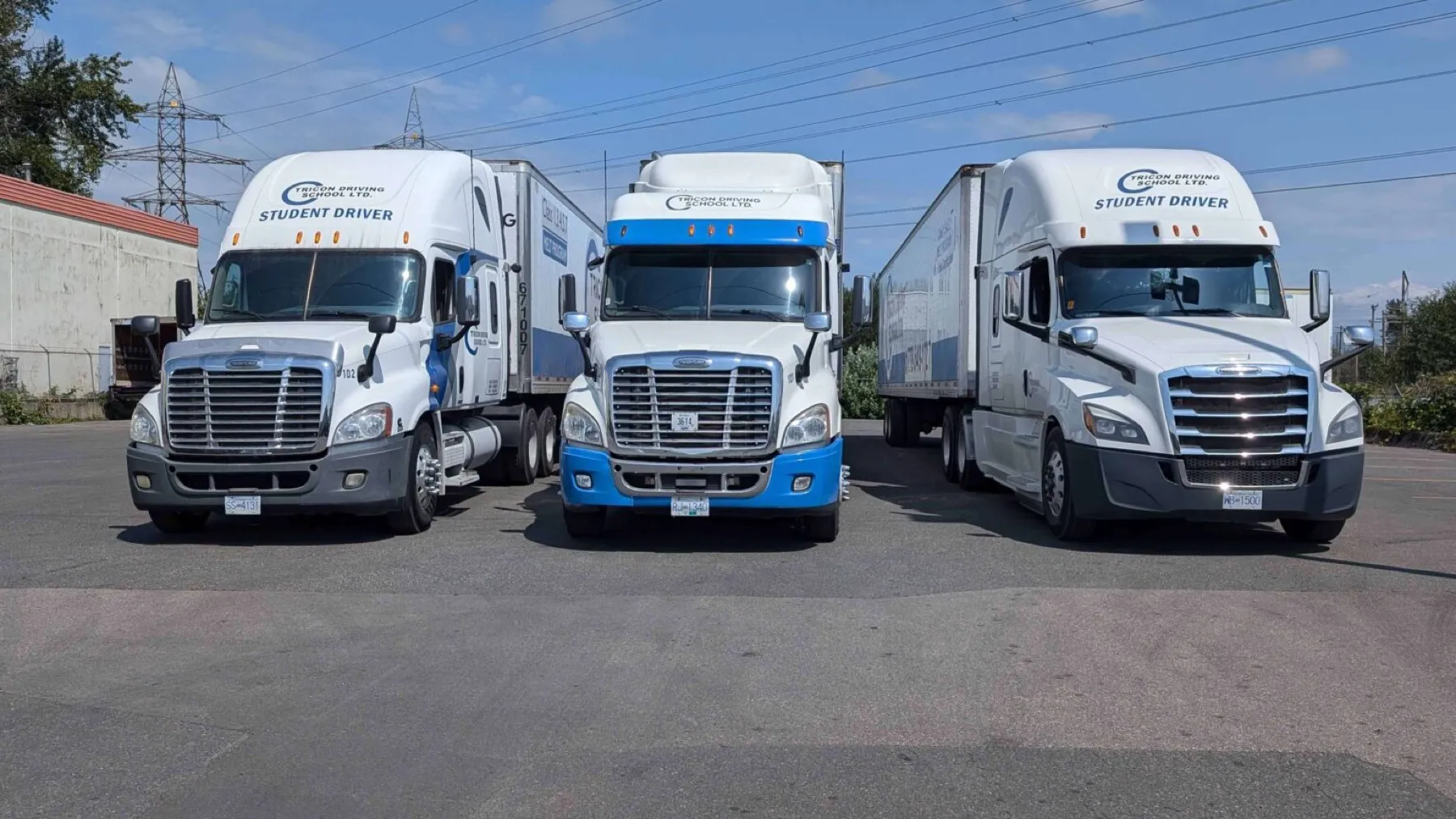
MELT, in plain language
MELT stands for Mandatory Entry-Level Training. It's the minimum training standard ICBC requires before you can take the road test for a Class 1 (tractor-trailer) licence in British Columbia. Before MELT became mandatory in October 2019, there was no minimum number of training hours required — a learner could, in theory, go straight from a learner's licence to a road test with little formal instruction.
MELT closed that gap. It sets out exactly how many hours of theory and practical training a new Class 1 driver must complete, and what those hours have to cover, before ICBC will test them.
The short version
MELT is 140 hours of ICBC-mandated Class 1 training — 47 hours of theory and 93 hours of practical training, including air brake certification and real on-road driving. See our Class 1 MELT course page for how Tricon delivers it.
The 140 hours, broken down
Every hour is logged against your name on an ICBC training record — it isn't a rough estimate, it's an exact standard every approved provider in B.C. has to follow.
ICBC also sets a calendar floor and ceiling: the course can't be completed in fewer than 30 days, and it must be finished within 365 days of your enrolment date. That's meant to stop training from being rushed through in a way that undermines the standard, while still giving students a realistic window to complete it.
Air brake training is built in
Air brakes aren't a separate add-on to MELT — they're part of the mandatory curriculum. B.C.'s MELT standard includes 9 hours of air brake theory and 6.5 hours of practical air brake training, 15.5 hours in total. That's close to double the minimum set by National Safety Code Standard 16, reflecting how much more mountain grades in B.C. demand of a brake system than flat-country driving does.
Passing the air brake component of MELT gets you the Code 15 endorsement on your licence. See our Air Brake Endorsement Explained guide for more on what Code 15 actually means, or our standalone air brake course if you already hold a licence and just need the endorsement.
What you need before MELT hours count
You can't just show up and start logging MELT hours — ICBC requires a few things first.
- A valid B.C. Class 1 learner's licence. Training taken before you hold it doesn't count toward your mandatory hours.
- A pass on the Class 1 knowledge test, which includes the air brake knowledge questions, plus the road signs test.
- Meeting ICBC's medical standards for commercial drivers.
- Manual vs. automatic transmission choice. Up to 10 of your on-road hours may be in an automatic; the rest must be in a manual with at least a 13-speed transmission. Qualifying entirely in an automatic gets you a restricted Class 1 licence that excludes manual-transmission vehicles — a real limitation for job prospects, so most students train manual. See our manual transmission training page for how the shift is taught, or Class 1 automatic transmission training for what the restriction covers if you're weighing automatic on purpose.
Our How to Get a Class 1 Licence in BC guide walks through the whole path from zero to licensed, step by step, if you're earlier in the process than this.
What to look for in a MELT provider
Every ICBC-approved provider has to deliver the same 140 hours on paper — but how those hours are actually spent can vary a lot. A few things worth asking about before you enrol anywhere:
Real road time, not just yard time
50 of your 93 practical hours are meant to be on-road. Ask how much actual highway and city driving you'll do, not just yard manoeuvres.
Actual mountain driving
B.C.'s terrain means mountain grades matter. Ask whether training includes real descents — see our mountain driving training.
Class size caps
ICBC caps class sizes: 15 students in a classroom, 10 in live virtual, 4 per instructor in-yard, and no more than 2 students per instructor and vehicle in the cab. Ask a provider how close to those caps they actually run.
ICBC-approved status
Confirm the school is an ICBC-approved MELT provider before you enrol — training from an unapproved provider won't count toward your licence.
See how Tricon delivers MELT
Full curriculum, trucks, funding options and the path from learner's licence to a Class 1 road test.
MELT — frequently asked questions
What does MELT stand for?
Mandatory Entry-Level Training. It's ICBC's minimum training standard for a Class 1 commercial licence in British Columbia, in effect since October 2019.
How many hours is MELT?
140 hours total: 47 hours of theory and 93 hours of practical training, made up of 19 hours in-yard, 18 hours of off-road manoeuvres, 50 hours of on-road driving and 6 hours of mandatory flexible practical time.
Does MELT include air brake training?
Yes. Air brakes are built into the MELT curriculum — 9 hours of theory plus 6.5 hours of practical training, 15.5 hours in total, which is close to double the National Safety Code Standard 16 minimum.
Do I need a learner's licence before starting MELT?
Yes. ICBC requires a valid B.C. Class 1 learner's licence before you enrol — training taken before you hold it doesn't count toward your mandatory MELT hours. To get it, you need to pass the Class 1 knowledge test and road signs test, and meet the medical standards.
Can I complete MELT in an automatic transmission truck?
Only partly. Up to 10 of your on-road hours may be in a vehicle with an automatic or automated transmission; the balance must be in a manual with at least a 13-speed transmission. Qualifying entirely in an automatic gets you a restricted Class 1 licence that excludes manual-transmission vehicles.
How long do I have to complete MELT?
ICBC sets both a floor and a ceiling: the course can't be completed in fewer than 30 days, and it must be finished within 365 days of your enrolment date.
What should I look for in a MELT provider?
Confirm they're ICBC-approved, ask how much real on-road and mountain driving time you'll get versus yard time, and check how close to ICBC's class-size caps (4 students per instructor in-yard, 2 per instructor and vehicle in-cab) they actually run.