
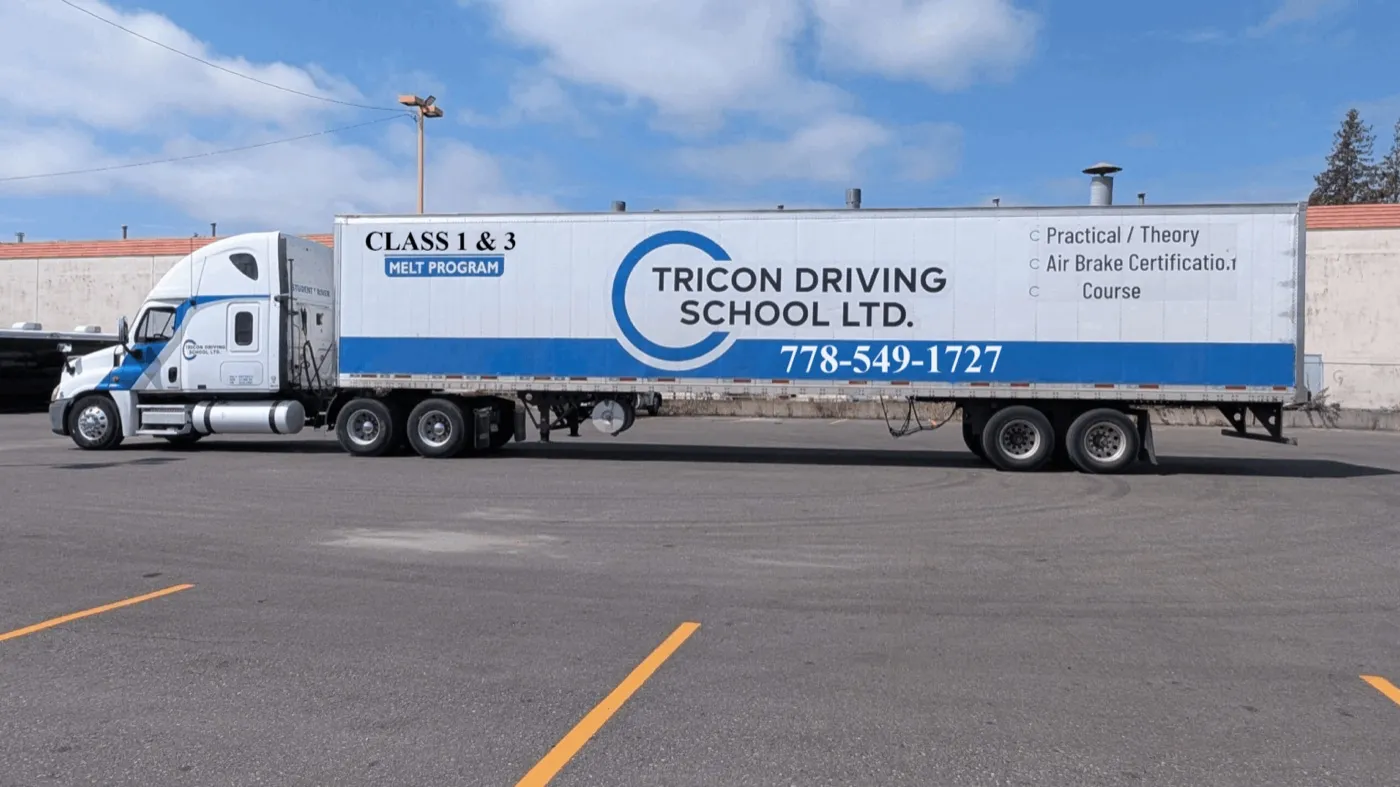
Why BC's terrain is a distinct skill
A driver can be fully licensed and perfectly competent in city traffic or on flat highway — and still be in real trouble on a British Columbia mountain grade in winter. Mountain driving isn't simply harder driving. It's a different problem, with its own hazards and its own techniques, and most of them are never tested on flat ground.
Corridors like the Coquihalla Highway (Highway 5) and the Fraser Canyon section of Highway 1 are well known in the BC trucking industry for exactly this reason: long sustained grades, tight canyon curves, and weather that can change completely between the valley floor and the summit — sometimes within the same trip. That combination is why British Columbia's Class 1 Mandatory Entry-Level Training (MELT) curriculum places more weight on mountain and highway driving than the baseline national standard requires. See our What Is MELT? guide for the full breakdown of what's in the 140-hour course.
The short version
Winter mountain driving asks a commercial driver to manage sustained grade, changing traction, and cold-weather equipment requirements all at once. This guide explains the concepts. For hands-on practice on real BC mountain highway, see Tricon's mountain driving training.
Chain-up and winter tire requirements
British Columbia's Commercial Vehicle Winter Tire and Chain-up regulation requires commercial vehicles travelling designated mountain highways to carry chains, or to be running qualifying winter tires, during the winter season. Where chain-up signs are posted and lit, drivers are required to fit chains before continuing — this is enforced, not a suggestion, and it applies on some of the same corridors, like the Coquihalla, where sustained grade already makes conditions demanding.
Exactly which highways, vehicle classes and date ranges the requirement covers can change from year to year, and enforcement is active at pullouts and weigh scales on affected routes. Knowing the general rule isn't a substitute for checking the current requirement before you drive.
Check current requirements before you go
Regulations, effective dates, and which highways are designated can change. Always check DriveBC and the BC Ministry of Transportation and Infrastructure's current chain-up and winter tire requirements before a winter trip, rather than relying on what applied last season.
Knowing the rule is one thing. Being able to actually fit chains to drive tires quickly, in the dark, at the roadside, in wind — is a physical skill that has to be practised, not just read about. See how Tricon trains chain-up on the ground below.
What brake fade is, and why it matters
On a long descent, a loaded commercial vehicle carries a huge amount of momentum. Every time the service brakes are applied, some of that momentum is converted into heat at the brake drums or discs. On a short hill that heat dissipates fine. On a sustained BC grade — ten, fifteen, twenty minutes long — riding the brakes continuously builds heat faster than it can escape.
Brake fade is the resulting loss of stopping power: as the brakes get hotter, they become progressively less able to convert speed into heat, so the pedal has to be pressed harder for the same result — and if the trend isn't reversed, stopping power can drop sharply and quickly. It's one of the most serious hazards on a long mountain descent, and it's largely preventable with the right technique.
- Lean on engine braking, not the service brakes. A lower gear and the engine brake or retarder can hold a loaded vehicle's speed on a grade with far less heat generated than continuous service-brake use.
- Recognise the warning signs early. A pedal that needs more pressure than usual, or a burning smell, means the brakes are already working harder than they should be — the time to react is the first sign, not the last.
- Use mandatory brake check pullouts as intended. They exist to catch a developing problem — heat, a dragging brake, a shifted load — before the next stretch of grade, not to be driven past.
This is general safety education, not a substitute for hands-on training. Recognising brake fade in a classroom is very different from recognising it at speed, loaded, on a real grade — which is exactly what Tricon's mountain driving training is built around.
General descent technique
Almost everything that matters about a safe descent is decided before the vehicle starts down the hill, not partway into it. These are general concepts every commercial driver should understand — not a replacement for supervised, hands-on practice on real grade.
Choose the gear before the crest
Reading the posted grade and length, and selecting a low enough gear before starting down, matters because a loaded vehicle that's already gaining speed may not allow a safe downshift partway through the descent.
Let the engine do the holding
Engine braking and proper gear selection reduce how much the service brakes have to do, which is what keeps them cool enough to still work when they're actually needed.
Know where the runaway lanes are
Escape ramps exist on major BC grades for a reason. Knowing where the next one is at all times — and being willing to use it — is part of professional descent planning, not a sign of failure.
Expect conditions to change with altitude
Rain at the bottom of a grade can be snow and ice at the summit. Watching for that shift, and adjusting speed and following distance before it surprises you, is part of the skill.
These are general concepts, useful for understanding what's involved — but a safe descent in practice depends on judgment built through supervised repetition on real grade, in real weather, with an instructor who can correct a mistake before it becomes a problem.
How Tricon's mountain driving training addresses this
Tricon runs mountain driving training on real, sustained British Columbia mountain highway — primarily the Coquihalla Highway (Highway 5) between Hope and Merritt, and the Fraser Canyon section of Highway 1 between Hope and Lytton. The Coquihalla gives long, high-speed, sustained grades with the province's best-known commercial brake check and runaway lane infrastructure; the Fraser Canyon gives tighter-radius curves, tunnels and older road geometry that punishes carrying too much speed into a corner. Which route is used on a given day depends on conditions and on what the driver needs to work on.
On the descent itself, training covers reading the grade and choosing a gear before the crest, engine brake and retarder discipline, snub braking technique, and recognising brake fade before it becomes a crisis. Students also stop at real mandatory brake check pullouts — including Zopkios on the Coquihalla — and are walked through what the stop is actually for: checking the air system, checking for heat or anything dragging, and confirming the load before committing to the descent.
Chain-up is trained physically, not just explained: students handle the chains, find the anchor points on the drive tires, and fit and remove them themselves, rather than doing it for the first time at the roadside under pressure. Winter sessions also cover how reduced traction changes descent technique — including why an engine brake can work against a driver on ice — and reading conditions that change between the valley floor and the summit.
Mountain and highway driving is a required Class 1 MELT practical assessment, so it's already included in Tricon's 140-hour Class 1 course at no extra cost. Drivers who already hold a Class 1 licence — including those licensed outside BC, or returning after time away — can also book mountain training on its own, as individual instruction by the hour, in Tricon's own trucks with an instructor who has driven these highways commercially.
Get on the hill with an instructor
Tell us what you drive and where you're being sent, and we'll tell you honestly how much time on the grade you need.
Winter & mountain driving — frequently asked questions
Is mountain driving training mandatory?
Highway and mountain driving is a required part of British Columbia's Class 1 MELT curriculum — it's one of the six practical assessments every new Class 1 driver must pass, and pass twice.
For drivers who already hold a Class 1 licence, dedicated mountain driving training isn't mandated by ICBC, but it's strongly recommended before running mountain lanes for the first time, especially in winter.
What's brake fade?
A loss of stopping power caused by overheated brakes, usually from riding the service brakes continuously on a long descent instead of relying on engine braking and gear selection. As heat builds, the brakes become less able to convert speed into heat, and stopping power can drop sharply if the trend isn't reversed.
Do I need chains even with a commercial truck?
Generally, yes. BC's Commercial Vehicle Winter Tire and Chain-up regulation requires commercial vehicles on designated mountain highways to carry chains or run qualifying winter tires during the winter season, and signed chain-up requirements are enforced.
Exactly which vehicles, highways and date ranges apply can change, so check current requirements on DriveBC and with the Ministry of Transportation and Infrastructure before a winter trip.
Does MELT cover mountain driving?
Yes. Highway and mountain driving is a required part of BC's MELT curriculum and one of the six practical assessments a student must pass. Tricon delivers it on real mountain highway, including the Coquihalla and Fraser Canyon, so it's built into the 140-hour course at no extra cost.
See our What Is MELT? guide for the full 140-hour breakdown, or our Class 1 course page.
Where does Tricon run mountain driving training?
Primarily the Coquihalla Highway (Highway 5) between Hope and Merritt, and the Fraser Canyon section of Highway 1 between Hope and Lytton. Which route is used on a given day depends on weather, road conditions and what the driver needs to work on.
How do I book Tricon's mountain driving training?
If you're enrolling in Class 1 MELT, mountain driving is already included — there's nothing extra to arrange. If you already hold a licence, or you're a carrier training a driver, it runs as individual instruction booked by the hour.
Call (778) 549-1727 or see the Mountain Driving Training page for details.