
Why British Columbia mountains are different
A driver can be fully licensed, competent in the yard, smooth in city traffic — and still be in serious trouble forty minutes east of Hope. Mountain driving is not harder driving. It is a different problem, and the mistakes it punishes are the ones nobody makes on flat ground.
On the prairies a grade is a feature you notice. In British Columbia a grade is a sustained condition you manage for ten, fifteen, twenty minutes at a time, fully loaded, with the entire weight of the combination pushing you down the hill. Service brakes convert that momentum into heat. Heat has to go somewhere. When it stops going anywhere, brakes fade — and a driver who did not plan the descent before cresting the summit has already run out of options by the time they notice.
This is exactly why B.C. wrote a heavier mountain component into its Class 1 MELT curriculum than the national standard requires. The province took the view that a driver licensed in Surrey could be loaded and descending a major grade within a week of being hired, and that this should not be the first time in their life they had ever done it.
The short version
Every ICBC-approved school in B.C. has to teach highway and mountain driving. What separates them is whether “mountain” means a real sustained grade with a brake check at the top, or the nearest convenient hill. Ask any school you are considering exactly which highway they use.
The routes we train on
We use two corridors, and they teach different things. Which one you get on a given day depends on conditions and on what you personally need work on.
The Coquihalla — Highway 5
Hope to Merritt. The long, high-speed, sustained grades this province is known for — the climb out of Hope, the Box Canyon and Great Bear snowsheds, the summit at Zopkios, and the descent toward Merritt. Commercial brake check pullouts and runaway lanes are built into the highway, and you will use them properly rather than drive past them.
The Fraser Canyon — Highway 1
Hope through Boston Bar toward Lytton. Older road geometry, tighter radius curves, tunnels, and rock on one side with the river on the other. It is less about raw grade and more about carrying the right speed into a corner in a vehicle that does not forgive being wrong — plus lane discipline in tunnels and around slow-moving traffic.
Both routes start from our Surrey or Langley yard, which means the session also includes the run out through the Fraser Valley — highway merging, sustained cruise, and the transition from valley driving into mountain driving. That transition is where a lot of new drivers stop paying attention, and it is where the planning has to start.
Descending a long grade
Almost everything that matters about mountain driving is decided before you start down. This is the core of what we teach, and we teach it in the seat, on the hill, with an instructor talking it through as it happens.
What you'll work on
- Reading the sign and doing the arithmetic. Percentage of grade and length of descent are posted for a reason. You learn to convert that, plus your loaded weight, into a gear choice before the crest — not after.
- Selecting the gear at the top. The rule that keeps drivers alive: choose your descent gear before you start down, because a loaded combination that is already accelerating may not let you get another gear at all. We put students in the position of having chosen wrong, safely, so the lesson lands.
- Engine brake and retarder discipline. When to use it, what it will and will not do for you on a wet or icy surface, and why it is a supplement to the right gear rather than a substitute for it.
- Snub braking. Firm application to bleed off a set amount of speed, then full release to let the drums or discs shed heat — instead of riding the brakes continuously and cooking them. This is the single technique most often taught badly.
- Recognising brake fade before it is a crisis. What the pedal tells you, what the smell tells you, and what to do about it in the first thirty seconds rather than the last five.
- Where the escape options are. Runaway lanes are not a disgrace. Knowing where the next one is, at all times, is part of the job.
The instructor is beside you, not behind a desk
Your first fully loaded descent of a major B.C. grade happens with someone in the passenger seat who has done it commercially, in every season, and who can tell you what you did half a second before you did it.
Brake checks and runaway lanes
British Columbia posts mandatory brake check locations before major descents, and commercial vehicles are required to stop at them. A great many new drivers treat this as a formality — pull in, wait, pull out. It is not a formality, and enforcement takes it seriously.
At the brake check we walk you through what the stop is actually for: confirming your air system, checking for heat and for anything leaking or dragging, confirming your load is still where you left it, and making the final gear decision with the descent in front of you rather than behind you. We do this at real brake check pullouts, including Zopkios on the Coquihalla.
Runaway lanes
We show you where they are and, just as importantly, talk through the decision to use one. The reluctance to commit — the belief that the situation is still recoverable, the worry about the cost of recovery and the conversation with dispatch — is what turns a recoverable brake problem into a fatal one. A driver who has thought that through in advance, with an instructor, makes the call faster.
Chain-up and winter driving
From 1 October to 30 April, commercial vehicles over 11,794 kg must carry chains on designated British Columbia mountain highways, and when the chain-up signs are lit you are required to fit them. This is enforced, and the penalty for being caught without chains — or without knowing how to use them — is not the worst outcome available.
We train chain-up physically. You handle the chains, you find the anchor points, you fit them and you take them off. Doing it for the first time on a shoulder at Zopkios, in the dark, in wind, with an officer waiting and traffic going past, is not the time to learn.
- Where B.C. chain-up requirements apply, and how the signage works.
- Fitting chains to drive tires, and checking tension after moving.
- Winter tire and chain equipment requirements for commercial vehicles.
- Reduced-traction descent — why an engine brake can work against you on ice.
- Reading changing conditions between the valley floor and the summit, which can be two different seasons on the same trip.
- When the correct professional decision is to shut down and wait, and how to have that conversation with dispatch.
Conditions change with altitude
It can be raining in Hope and snowing at the summit on the same afternoon. Part of the training is learning to anticipate that rather than discover it.
Who this training is for
Class 1 MELT students
Mountain driving is a required MELT assessment and it is built into your 140 hours at no extra cost. You do not book it separately — it is part of the course.
Licensed drivers new to B.C.
Drivers who earned a Class 1 on flat ground, or in another country, and are now expected to run mountain lanes. Booked by the hour, built around what you need.
Drivers returning after time off
Skills that were solid five years ago fade. A focused session on the hill is a cheaper way to find that out than a loaded trip with a deadline.
Carriers and fleet managers
Send a new hire up the hill with an instructor before you send them up with a load. We also run pre-employment road tests and corporate assessments.
How to book
If you are enrolling in Class 1 MELT, mountain driving is already included — there is nothing extra to arrange. If you are a licensed driver or a carrier booking mountain training on its own, it runs as individual instruction and we schedule it around conditions and around you.
We are open 9am to 9pm every day, including weekends and holidays, from our Surrey and Langley yards. Sessions leave from whichever yard is closer to you.
Tell us where you're being sent
Give us the lane you'll be running and what you're pulling, and we'll tell you honestly how much time on the hill you need — and what it involves.
Mountain driving training — frequently asked questions
Is mountain driving part of the Class 1 MELT course?
Yes. Highway and mountain driving is one of the six practical assessments B.C. requires in the 140-hour Class 1 MELT curriculum, and it has to be passed twice. B.C. deliberately wrote a heavier mountain component into its version of MELT than the national standard asks for.
What differs between schools is where those hours are spent. A school can satisfy the requirement on comparatively gentle highway. We run ours on real sustained mountain grade, including the Coquihalla.
Can I take mountain driving training if I already have my Class 1?
Yes. A large share of the drivers we take up the hill already hold a Class 1 — drivers licensed on the prairies or in a flatter province, drivers coming back after years off, and drivers whose new employer runs mountain lanes and wants them coached before their first loaded trip.
It is booked as individual training by the hour rather than as a course, so it is built around what you actually need. Call and tell us what you drive and where you are being sent.
Where exactly do you go?
Primarily the Coquihalla Highway (Highway 5) between Hope and Merritt, and the Fraser Canyon section of Highway 1 between Hope and Lytton. Which one we use on a given day depends on weather, road conditions and what you need to work on.
The Coquihalla gives you the long, steep, high-speed sustained grades and the province's best-known brake check and runaway lane infrastructure. The Fraser Canyon gives you tighter radius curves, tunnels, and older road geometry that punishes a driver who is carrying too much speed into a corner.
Do you train chain-up as part of this?
Yes, and we train it on the ground rather than only on a whiteboard. You will handle the chains, find the anchor points on the drive tires, and fit them.
In British Columbia, commercial vehicles over 11,794 kg travelling designated mountain highways must carry chains from 1 October to 30 April, and signed chain-up requirements are enforced. A driver who has never fitted a chain before the first time an officer sends them to do it at Zopkios in the dark, in wind, is in a bad position.
What if the weather is bad on my scheduled day?
Winter conditions are the point, not an obstacle — some of the most valuable training happens in weather. What we will not do is take a student up in conditions that are genuinely unsafe for a training vehicle, or when the highway is closed.
If we have to move a mountain session for road closures or extreme conditions, we reschedule it. You do not lose the hours.
Do you use your own trucks?
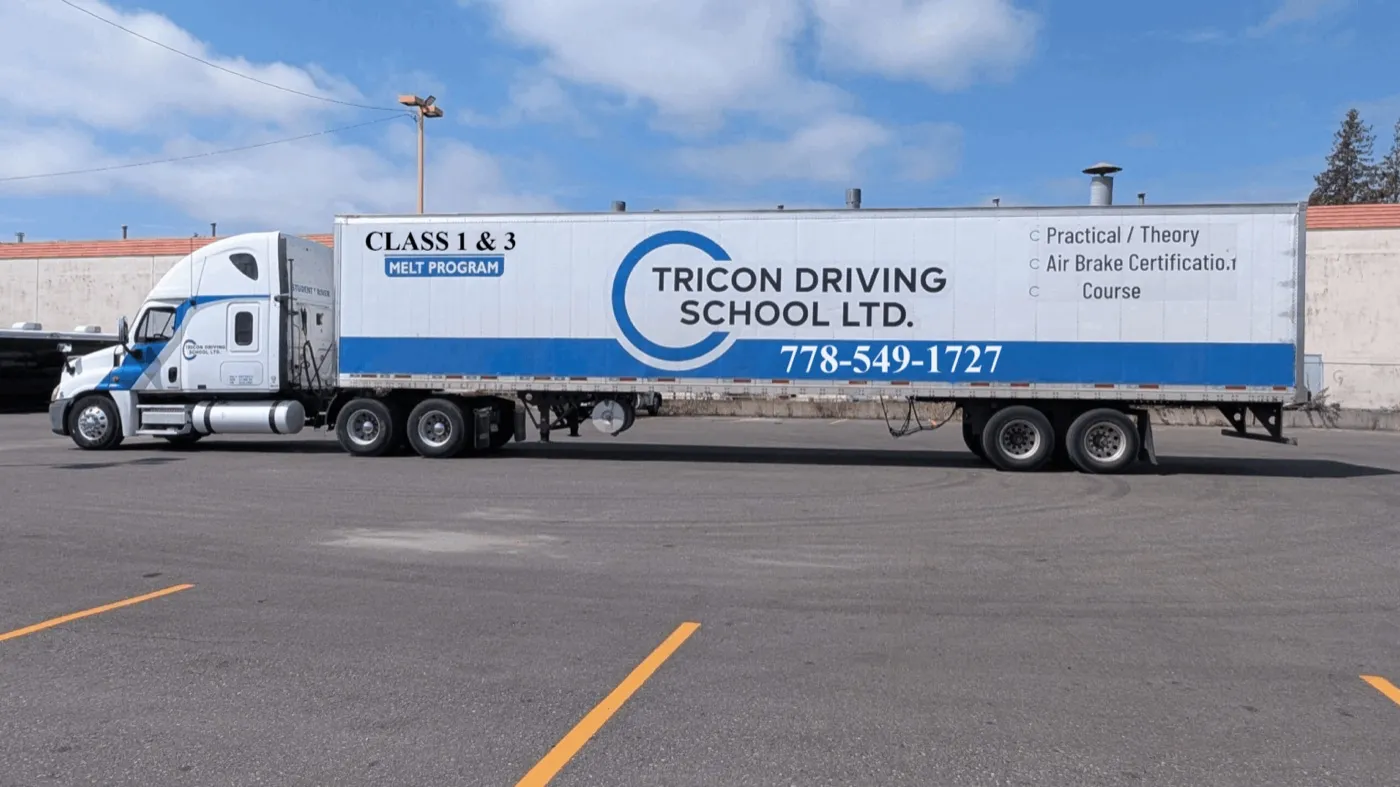
Yes. Every mountain session runs in a Tricon tractor-trailer maintained by us, with an instructor beside you who has driven these highways commercially. You are not taking a rented truck up an unfamiliar grade.