
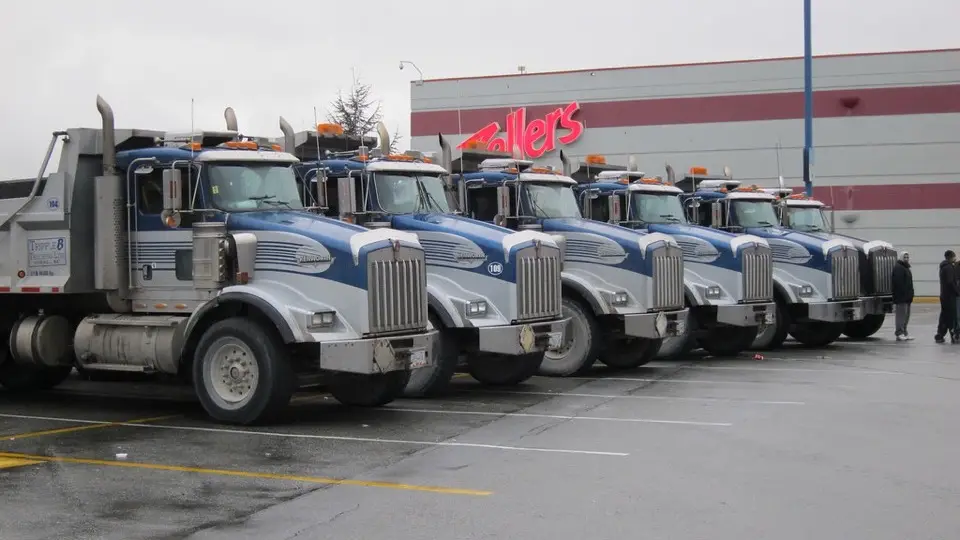
What a Class 3 licence lets you drive
A Class 3 licence lets you drive a straight truck — a single vehicle, not a tractor-trailer — with more than two axles: dump trucks, large tow trucks, tank trucks, garbage and fire trucks, cement mixers and most municipal trucks. It also covers everything a Class 5 allows, so you lose nothing you already have.
Almost every Class 3 truck has air brakes, so almost every Class 3 driver also needs the air brake endorsement (code 15). A Class 3 does not cover tractor-trailers (Class 1), buses (Class 2 or 4) or taxis and ambulances (Class 4). The full list is on our Class 3 page, and if you are deciding between the two truck licences, read Class 1 vs Class 3.
In short
Be 18+ with a full Class 5 or 6. Pass the Class 3 knowledge test (35 questions, 28 to pass), the road signs test and, for an air-brake truck, the air brake test (25 questions, 20 to pass). Train on your learner’s licence, pass the ICBC road test with its pre-trip inspection, then have your doctor complete the medical form. There is no MELT and no minimum hour count.
The process, start to finish
Here is the whole sequence at a glance. Each step is explained below.
-
Check you qualify
Age 18+, a full-privilege Class 5 or 6, a clean enough record and nothing owed to ICBC.
-
Study and take the air brake course
ICBC’s Driving Commercial Vehicles guide, plus an air brake course before the air brake test.
With a school like us -
Pass the knowledge tests
Class 3 knowledge, road signs and air brake tests, after a vision check and health questions.
At an ICBC office -
Get your learner’s licence and train
Valid for one year. Practise with a supervisor or at a driving school.
With a school like us -
Pass the ICBC road test
Booked by phone. Pre-trip inspection (with air brakes), then the drive, in a Class 3 truck.
At an ICBC office -
Medical form and photo licence
Your doctor completes the Driver’s Medical Examination Report; RoadSafetyBC reviews it.
With your doctor
Step 1 — Do you qualify?
These rules are set by ICBC and decided on your record, not by a school.
- 18 or older. That is a year younger than Class 1, 2 or 4. ICBC needs a parent or guardian’s consent if you are 18.
- A full-privilege B.C. Class 5 or 6 licence (or an out-of-province equivalent). A Class 7 novice licence does not qualify.
- Fewer than four penalty-point incidents in the past two years.
- No driving-related criminal convictions in the past three years.
- No unpaid ICBC fines or debts. Money owed to ICBC stops your application at the counter.
- The commercial medical standard. ICBC checks your vision and asks health questions when you apply for the learner’s licence.
Not sure where you stand? That is a five-minute phone call: (778) 549-1727.
Step 2 — Study, and take the air brake course first
Everything on the Class 3 knowledge test comes from ICBC’s free Driving Commercial Vehicles guide. The Class 3 study chart includes the air brake chapters.
ICBC requires an air brake course (or acceptable proof of air brake experience) before you take the air brake knowledge test. It is not needed for the Class 3 knowledge test itself, but if you want to take both tests in one visit, do the course first. Our air brake course is 7 hours of theory and 4 hours of practical, and it is the standard course for our Class 3 students. More in our air brake endorsement guide.
Step 3 — The knowledge tests
Book an appointment at an ICBC driver licensing office. You take the tests on a screen, after a vision check and medical questions.
| Test | Questions | To pass | Practise free |
|---|---|---|---|
| Class 3 knowledge | 35 | 28 (45 minutes) | Class 1 & 3 practice test |
| Air brake (if the truck has air brakes) | 25 | 20 | Air brake practice test |
| Road signs | Taken with the knowledge test | Road signs practice test | |
Taking a commercial knowledge test and the air brake test together costs one fee.
Step 4 — Your learner’s licence and training
Pass the tests and ICBC issues your Class 3 learner’s licence. It is valid for one year and lets you practise driving a Class 3 truck with a supervisor or at a driving school.
There is no MELT for Class 3 and no ICBC minimum number of hours. How much training you need depends on what you can already do behind the wheel. Good training covers the NSC 13 pre-trip inspection, air brake systems and adjustment, backing and tight-space manoeuvres, and city and highway driving in a Class 3 truck. See Class 3 training in Surrey and Langley.
Manual or automatic decides your licence
Pass your road test in an automatic and ICBC restricts your licence to automatic transmission (code 28). Pass in a manual and there is no restriction. Fire and garbage trucks are often automatic; older dump trucks are often manual. Compare Class 3 manual and Class 3 automatic.
Not sure which step you’re on?
Tell us what’s on your licence today and we’ll map out exactly what’s left — no obligation, no sales pitch.
Step 5 — The ICBC Class 3 road test
You phone ICBC to book; a commercial road test cannot be booked online. You take it in a Class 3 truck, and it opens with a pre-trip inspection, including the air brake pre-trip if the truck has air brakes, before the on-road drive. Bring the tools for an air brake adjustment.
More road tests are lost on the pre-trip than on the drive. Practise it with our pre-trip inspection checklist, and see ICBC road test locations in BC. Already close to test day? Our Class 3 lessons and road-test truck are booked by the hour.
Step 6 — After you pass: medical and photo licence
You pay the licence fee and get a temporary licence, plus a Driver’s Medical Examination Report form for your doctor. Your photo licence is mailed once RoadSafetyBC confirms you meet the commercial medical standard. Commercial drivers also have medical exams on a schedule after that, so keep an eye on the deadline on any form ICBC sends you.
What a Class 3 licence costs in BC
There are two separate costs: ICBC’s fees, which are small and fixed, and your training, which is the larger part.
ICBC’s fees
In October 2026 ICBC listed $15 per knowledge test attempt and $50 for a Class 3 road test, with the pre-trip inspection included. A $25 fee applies if you cancel a road test with less than 48 hours’ notice. The licence fee is paid when you pass. Check ICBC’s fees page for current amounts.
Your training
ICBC does not set training prices; every school quotes its own. Ours depends on your experience and on manual or automatic, so we quote by phone after a short chat. See what a Tricon fee covers.
Your medical
What your doctor charges to complete the medical report is between you and them.
Funding
The B.C. Employer Training Grant can help if an employer sponsors you, other provincial programs may apply, and we offer in-house funding too.
Where people get stuck
- Going to ICBC before the air brake course. You can pass the Class 3 test that day but not the air brake test, and you need a second visit.
- Choosing automatic without thinking about the job. The code 28 restriction rules out manual trucks until you pass another road test.
- Underestimating the pre-trip. It is pure preparation and entirely in your control.
- Assuming Class 3 counts toward Class 1. It does not; a first Class 1 still needs the full 140-hour MELT course.
- Unpaid ICBC fines. Clear them first or your application stops at the counter.
Class 3 licence in BC — frequently asked questions
How do I get a Class 3 licence in BC?
Be 18 or older with a full-privilege B.C. Class 5 or 6 licence. Pass the Class 3 knowledge test and road signs test at an ICBC office (plus the air brake test if your truck has air brakes) to get your learner’s licence, train in a Class 3 truck, then book and pass the ICBC road test, which opens with a pre-trip inspection. After you pass, your doctor completes a Driver’s Medical Examination Report.
How much does a Class 3 licence cost in BC?
There are two parts. ICBC’s own fees are small: in October 2026 ICBC listed $15 per knowledge test attempt and $50 for a Class 3 road test, with the pre-trip inspection included when taken with the road test, plus the licence fee when you pass. Check the ICBC fees page before you go.
The larger part is training. ICBC does not set training prices; each school quotes its own. At Tricon the price depends on your experience and whether you train in a manual or an automatic, so call (778) 549-1727 for a quote. Funding may cover part of it.
How many hours of training do I need for Class 3?
ICBC does not set a minimum. Mandatory Entry-Level Training (MELT) applies only to a first B.C. Class 1 licence. How many hours you need depends on what you can already do behind the wheel, which is why we assess you first and give you an estimate before you book.
What is the difference between Class 1 and Class 3?
Class 1 covers tractor-trailer combinations and needs the 140-hour MELT course and a minimum age of 19. Class 3 covers straight trucks with more than two axles, such as dump trucks, with no MELT requirement and a minimum age of 18. See our full Class 1 vs Class 3 comparison.
Can I get a Class 3 licence at 18?
Yes. 18 is the minimum age for Class 3, a year younger than Class 1, 2 or 4. You also need a full-privilege Class 5 or 6 licence; a Class 7 novice licence does not qualify. ICBC needs a parent or guardian’s consent if you are 18.
Do I need an air brake endorsement for Class 3?
Almost always. Most Class 3 trucks have air brakes, and you cannot drive one without the code 15 air brake endorsement. ICBC requires an air brake course, or acceptable proof of air brake experience, before the air brake knowledge test. Our air brake course is 7 hours of theory and 4 hours of practical.
Should I take the Class 3 road test in a manual or an automatic?
If you pass in an automatic, ICBC restricts your licence to automatic transmission (code 28). Pass in a manual and there is no restriction. Many fire trucks and garbage trucks are automatic, while older dump trucks are often manual, so choose for the job you want.
Do I need a Class 3 licence to be a firefighter in BC?
Most Lower Mainland fire departments ask recruits for a Class 3 with air brakes, some at the application stage. An automatic Class 3 is usually accepted. Check the requirements of the department you are applying to.
Facts checked against ICBC’s published requirements on 22 October 2026. ICBC rules and fees can change, so confirm with ICBC before you book.